MORE AWESOME Transcripts from the legal field podcast
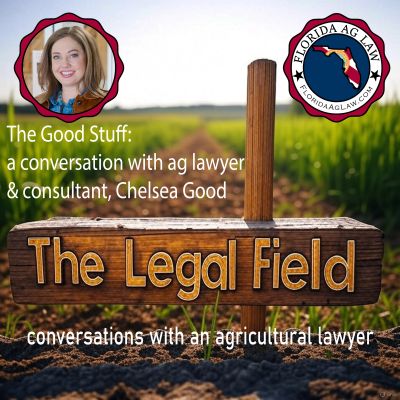
Season:2 Episode : 8 - The "Good Stuff"
Amanda Perry Carl 1:10
To help our sort of industry survive. Our sort of space to eat and you appreciate our agreers. This podcast is for you. If you are interested in protecting and preserving our agricultural heritage, lands, and way of life, then come join us in the legal field and see what's growing on. Welcome to another edition of uh the Legal Field Podcast. My name is Amanda Carl, and I am your podcast host, and I am so excited to welcome today's guest to the podcast, a fellow agricultural lawyer from a different part of the country, Chelsea Good. Chelsea is the owner of Good and Associates, an agricultural consulting and advocacy firm in Kansas. So welcome, Chelsea.
Chelsea Good 1:55
Thanks so much for having me on, Amanda. I'm looking forward to our conversation today.
Amanda Perry Carl 1:59
Same here. I think it'll be really exciting to hear about, you know, our different backgrounds and things, how things are maybe a little different in different parts of the country, but how a lot of our issues really are some of the same issues. For sure. And I'm always excited to get to know other ag lawyers and advocates. Um I think what we do is such a niche practice and is so critical for the survival of this industry that we love so much.
Chelsea Good 2:27
Absolutely. Um it's you know, something I'm really passionate about.
Amanda Perry Carl 2:31
And you've had a really incredible career taking that passion. And I know our listeners would love to hear a little bit about your background, even before we get rolling very much in the podcast and some of the things maybe that you've worked on. Can you give our listeners a little primer on who you are and maybe a bit of your background and how your passion for this industry began?
Chelsea Good 2:51
Oh, I would love to. Um, I think it's in my blood. Um, you know, I was kind of born into it. Um, my dad, um, Kevin Good works at Cattlefax, he's a livestock market economist, um, starting to stair step towards retirement, not full-time anymore. Um, but that's the job he took out of college. Um, and so I was born in Parker, Colorado to a livestock market economist. Um, and you know, by the time I was eight, it was mom and dad's goal that we would have acreage so I could show. Um, I think they got that done when I was six. So the place I grew up on, you know, had a barn and enough space for me to have cattle and um, you know, hogs and unfortunately some sheep and goats, um, kind of anything I wanted to show that wasn't horses was um eligible. And um dad grew up actually on a cow calf operation in Michigan. So um, grandpa good, Fred good, um, who actually just passed away last year at 101, which I think is pretty phenomenal legacy. Um that's yeah, it just just amazing. Um, grandma and grandpa lived on the farm until um I think she was ninety five or six, and he was ninety-nine when they they stopped living on the farm by themselves.
Amanda Perry Carl 4:07
What an incredible story. You know, I think it's it's really a testament probably to their tough genes and their tenacity to be able to stay there on their own until that part that point in life. It's a pun, but I've got good genes, right?
Chelsea Good 4:20
Right.
Amanda Perry Carl 4:22
There's a lot to be said there.
Chelsea Good 4:24
Yeah, and there's actually kind of a fun tie-in here. Um, so I went I named my firm that I launched last July, Gooden Associates, um, had a couple different reasons. Um, you know, I have a strong livestock marketing background, and it kind of sounds like it could be like a sale management firm. Obviously, I'm an attorney, it sounds like it could be a law firm. In reality, it's kind of neither in both. Um, but the the thing that was like, man, this is absolutely what I have to name it, is Grandpa Good had a club calf sale that he called Gooden Associates. And um it was his sale, but then he would bring in other producers and they would have offerings from them as well. And that's kind of the way my business works that I'm a sole proprietor, but I've got a lot of collaborators um that will either subcontract with me or, you know, from a legal perspective, sometimes I'll do some cross-referrals. Um, and so, you know, my business model is similar to the way he did his club calf sale. And it was fun to get to kind of give a nod to him and that legacy and what I chose to name the business.
Amanda Perry Carl 5:25
What an incredible way to carry on that legacy and to keep that family legacy alive. You know, I think that that so often, and we can talk about this a little bit more later, too, but so often there aren't a whole lot of lawyers who have that agricultural background and legacy. And I love that nod to your family's agricultural legacy in the name of your law firm.
Chelsea Good 5:48
Well, it it remind me, Amanda, you're a country music person, right? I am huge country, old country music. Yes, uh classic country, real country. So I'll take it a step further. Um, Grandpa had a couple brothers. Um, Don Good would be kind of the best known in Kansas. He was the animal science department chair for a long time. He actually picked the first crossbred steer to win a major international show. Um, it was named Conico, it was a Shar cross that he picked to win the Chicago in 1969 and really changed a lot of people's opinions on crossbreeding. Um, but grandpa had another brother, his brother Paul, who was a wonderful livestock auctioneer. And Paul actually used to run around with Leroy Van Dyck. Oh, how incredible. Oh yeah. So that song, The Auctioneer, Leroy's most famous song, there was a family rumor that that song was about Great Uncle Paul. Um, it wasn't, it was about Ray Sims, but um I actually, just like a month or so ago, woke up one day and I was like, you know, I think Leroy Van Dyke's still alive, and I wonder if he would talk to me. And I looked him up, and he is 96, and I found his wife's email and I emailed her, and I actually had like an hour-long conversation with Leroy Van Dyke a couple weeks ago about my great uncle that he knew really well, and also my grandpa, who he knew. What a cool story.
Amanda Perry Carl 7:09
Now that he confirmed who the song was about.
Chelsea Good 7:11
It was definitely about Ray Sims, who's a cousin of his. Um, and then the other family rumor that I had to dispel, um, my cousin Adam Goodcotton, his story was always like, Yeah, it's about Ray Sims, but Leroy Van Dyke and Paul Good were on a plane together, and Paul helped write the song. Um, turns out Leroy wrote the song in Korea. It was actually a really cool story. He thinks the song wrote itself. He said that like the lyrics just kept coming to him when he was serving in Korea, and eventually he wrote them down.
Amanda Perry Carl 7:41
You know, I love these family stories sometimes, and sometimes you you want them to be true, and sometimes you think, man, I hope this isn't true. We have one of the stories in our family. Um, we mentioned before we got on the podcast, my family's been in Central Florida since 1823 before, you know, air conditioner and refrigeration. And I often wonder, you know, what the heck they were doing here. But, you know, the the old story about our family is that the man that our little hometown was named after, Peter Boyer Perry, our town was named Pedro, should have been Pedro in Spanish. The legend was he was the first um American to raise the American flag in Mexico during the Mexican-American War.
Chelsea Good 8:22
Oh, cool.
Amanda Perry Carl 8:23
Who knows? Probably no truth to that story, but that's our family story.
Chelsea Good 8:27
Run with it, right? That's too good to not be true.
Amanda Perry Carl 8:30
Right. So I absolutely understand these family stories and legacies that may or may not be true, but they they carry on from generation to generation, and it's really fun to carry some of these things on.
Chelsea Good 8:40
Yeah, it's funny on my mom's side, my grandpa Bach, um, who was a little wild, um, he loved talking about how we had Indian blood, right? And you know, we were part Indian Indian. Um, and then DNA tests and 23andMe came along, and that it's a bold-faced lie. We're German and Irish. Um, but according to Grandpa Bach, there's Indian blood in there somewhere.
Amanda Perry Carl 9:02
You know, maybe the 23andM was wrong. We'll we'll just leave it at that. Maybe it's I mean, how would they know? Right. Maybe it was wrong. So you have this amazing passion, you know, for ag and an incredible background in this industry, which is really amazing. What inspired you to go to law school and continue this passion of advocating for this industry with a law degree?
Chelsea Good 9:27
So I think two things. Um, the first thing was the decision that the cattle sector is where I belonged. Um, and that probably, if if it didn't happen earlier, was solidified at least by high school. Um, I had the privilege of being selected as a national beef ambassador. I got sent to my first um cattle industry convention, I think it was in Phoenix, and there was all of these cowboys from different parts of the US arguing about policy and and you know how something would affect a cattle feeder versus a stalker versus a cow calf guy. And I was just like, if I do nothing else in my entire life, I would be happy sitting in this room arguing with these men and women and arguing on their behalf. Like I just knew that the cattle sector was for me, the people were for me, and and there was something about policy that was pretty special. Um the decision to go to law school happened a little later, probably mid-college. Um, you know, dad planted the seam or seed early. He said, you know, I liked to do, yeah, I like to argue too much to be anything but a lawyer, right? Um, but I didn't think I wanted to be a litigator. Or I I would have loved to be a litigator if I could pick the cases and they were all about cattle, but that's not how being a litigator works. So it wasn't for me, right? I think I knew I wanted policy, but I I developed this passion in college for advocacy as well. And, you know, in policy, we're advocating on behalf of producers to decision makers, but it was my opinion, and and just for context, I'm in undergrad, um, judging livestock at Butler 04 to 06, um, finishing up at K-State 06 to 08. And, you know, social media was pretty new. Like literally, Facebook. When I first got Facebook, you had to belong to a college that it got released at. And so I was like, the worst two weeks of my life were when K-State had Facebook already, but because I was at Butler, I didn't yet. Um, right. So, you know, an interesting time in social media, an interesting time in people saying, you know, we're gonna start to use the internet to connect people, to talk about things with people that come from different viewpoints. And, you know, Chipotle at the time was doing some things where they talked about conventionally raised meat in ways that I thought was unfair. And so, you know, I had this additional passion kind of be lighted about advocating to consumers and um really even more so than advocating to consumers, creating ways to have real conversation with consumers where we both listen to them and also um share with them about our experiences. And this was pretty new at that point in time, right? And so I have these dual passions. I know it's cattle sector, I know it's policy, but maybe there's also something here on communications that that's speaking to me as well. I loved K-State. Um, if anybody is looking at colleges, go to Manhattan, Kansas and consider Kansas State University. It was a phenomenal place for me. Um, so phenomenal that I wasn't quite ready to leave after two years. So I actually stayed an extra year and got a master's in um persuasion, communication studies. Um, I did thesis research on rural beef producers and talking to urban consumers and whether data and numbers was more persuasive or stories and narratives. And um found what I kind of expected, and that was if you're talking to a broad audience, it really takes a blend of both. And well, I wasn't surprised by that. I think that we're in such a data-driven industry that there were cattlemen out there and women that needed to see the data to learn that just data is not a lot, not enough for a lot of people, and they need to tell the story as well.
Amanda Perry Carl 13:19
Absolutely. And I think what you say there is so important about that time. You know, I think when all this social media and all these things were happening, I often say that as agriculture as a whole, all across all industries, we got a little bit behind in getting our message out there and communicating because I think so often in our industry, we know we're doing great things. You know, our farmers and ranchers know that they're stewards of the land, that they're doing all these things, and they just assume everybody knows. And I think in some ways, in those early days, we let the mommy bloggers and some of the others get ahead of the narrative. And then, you know, we've kind of had to play catch up. And I love to hear that you were, you know, kind of on the forefront trying to get that message across because I think it is so important. People need to hear our stories, they need to hear and they want to hear about the farmers and ranchers that are out there producing their food because they hear so much noise from the some of the other groups about factory farming and some of these buzzwords that just really aren't true.
Chelsea Good 14:20
Absolutely. Um, I totally agree with that. And so that that kind of lit, you know, a different passion there. Um, and so I um really, you know, had a great experience in that master's program. Probably need to give Dr. Dan Thompson some credit. He ran the K-State Beef Cattle Institute at that point in time, and so um he found funding for that and was very supportive and made it so that even though I was not in the College of AG, I really, you know, was having an ag-based conversation and able to do ag based research that was funded. Um I did just a year to get my master's, which was a little wild, but um, I think you'll find I like doing a lot really quickly. Um probably don't have any other pace. And so um I um after that, um, that's when I chose to go to law school. And you know, dad was encouraging, and and mom, yeah, my whole family was very encouraging. Um, and dad even said, you know, when I was in undergrad and a little bit bored and not not challenged enough, he said, you know, stick it out. And, you know, if you if you do well in undergrad and you get to law school, we'll help you pay for law school, which is, you know, amazing to have that family support. Lots of people don't, right? Absolutely. And um I have this day that I will never forget. Uh Todd Johnson was leading the Kansas Beef Council at the time, and um we had the very first ever Masters of Beef Advocacy training at K-State. Todd through the Beef Council, me through um doing some work for Dr. Dan and the Beef Cattle Institute and this group we'd set up called Um Food for Thought, we had the very first ever training for um the um Masters of Beef Advocacy. Darren Williams came out and did it. He didn't even have all of the modules done yet. I mean, we were, you know, aggressive. Well, that same day, Washburn, where I ended up going to law school, invited me to do some interviews um for a scholarship. And so I had to leave in the middle of the day to go interview for scholarship. And on the way home, I got a call to my cell phone and said, you know, congratulations, Chelsea. We have one full ride plus stipend. We offer a year and we want to offer it to you. That is awesome. Uh law school is huge. Yeah. More more awesome than that was the call I made to my dad, where I said, Hey, thank you so much for being willing to support me going to law school. I'm not gonna need it. Um, that was just like, I hope he remembers that phone call the same way I do, because I was just so proud, right? That all of my hard work had paid off and that people were willing to invest in me, and that like I didn't need his funds to make law school happen. I was gonna be able to do it um in another way. And then to later on, um, National Cattleman's Foundation selected me weeks after that to receive a WD FAR scholar, which was also life-changing. I mean, I think that was $12,000 or $15,000 at a point in time where that felt like a million dollars. Absolutely.
Amanda Perry Carl 17:28
Especially when you're a law student and you know that money goes a long way in to not have to come out with student loan debts or to be able to say to your father, look, I can take care of this on my own. That's huge. It was.
Chelsea Good 17:40
I then had to call him not long thereafter because um I decided that I was gonna buy a house because my best friend Christy Gable was buying a house. She had a job, she could afford a house, right? I just decided if Christy gets to buy a house, I get to buy a house. Um and so I, you know, got pre-approved for the loan and found the house and it was super cheap. And there was a first-time home buyer tax credit, and everything was great until they go to you know, verify my employment. And my employer logically says, Well, yeah, she works for us, but she won't in a month when she goes to law school. And apparently that changed the lender's risk analysis on me. So I did have to call dad and ask him to co-sign that loan.
Amanda Perry Carl 18:20
But you had already taken care of law school, so that was a little stressed.
Chelsea Good 18:24
I did, and he never had to do anything but co-sign. And then when I refinanced a couple years later, I took him off of it. Um, but you know, still needed dad just in a different way.
Amanda Perry Carl 18:34
Yeah, it's sometimes it's always good to still need your dad a little bit. I still make phone calls to mine all the time to ask all kinds of questions.
Chelsea Good 18:40
For sure. I mean, he is my favorite sounding board, right? And like now this sounds like a Kevin Good fan show, which was not anything I wrote down in my notes, but is a lot of my background, right? Like that's I think that passion came through both of my parents, but in different ways. You know, mom is a very passionate human. Her passion is for people and connection and and personality is where mom and I are similar, interests is where dad and I are similar.
Amanda Perry Carl 19:08
That's incredible. So you you graduated from law school then, you know, and then have had a really cool, I think, career since then. Um, and now you've started your own practice. Can you tell our listeners a little bit about your career to this point and then starting your own firm and what helped you make that decision? Sure.
Chelsea Good 19:27
So um career kind of jump started a little bit during law school. Um, I have a mentor, Jackie McClaskey, who believes people that are young can do big things, and she picked me as one of those people. And so Jackie actually invited me to um interview and become the communications director for the Kansas Department of Agriculture while I was in law school, which was a little wild to take a full-time job midway through law school, but it worked great. Um, it was phenomenal. I learned so much. So I did that for a couple of years, um, graduated and took the bar. And so when I passed the bar, I told Jackie and the crew at KDA, like, I've loved this job, but I became an attorney on purpose. Like, I think that I need to um see that out. I need to um, you know, have an opportunity to see if I if I, you know, like practicing law. And Jackie's like, you don't like practicing law. And I'm like, you might be right, but I uh I need to feel that, right? And so I actually transferred to the legal team at the Kansas Department of Ag. So stayed with KDA, but became an attorney, focused on um Animal Health Division, which was a great fit, um, worked with Dr. Bill Bray on the state vet, learned a lot. Um, I think that I um, you know, loved pieces of it. I loved working on policy, I hated you being a regulator. And so a couple years after that, or maybe even just a year after that, I started started to think, you know, what's next? And do I need to go to DC? Is that's the only way you really can do these things, blah, blah, blah. Um, and so I'm thinking about going to DC. And um I got a call from a couple people that said, Hey, you know, your name is getting talked about for this livestock marketing association, vice president of government and industry affairs job. You should really consider it. Um, and I'd actually seen the posting. I'd sent it to Christy, my best friend, and we had agreed that they wouldn't consider me because I was so green, right? But enough people said my name to Mark Mackey, the CEO at the time, that Mark said, let's bring her in and talk to her. Um, and so I um I ended up um interviewing and getting the job with LMA, which is was a huge blessing. That was 2013. I moved to Kansas City, led the government affairs and legal team for LMA for about 12 and a half years. Um, did great run, did really cool things. I'd love to talk about dealer statutory. Trust and some of the big wins we had for the sale barns in that role. But um this time last year, I started to think um, you know, I was about to turn 40. I've always considered myself a little bit of an entrepreneur. I'll I I told my husband at one point when we were dating that I wanted to be a serial entrepreneur when I grew up. And he just looked at me and he goes, Chelsea, why don't you start with one? Which is like so logical. And also the role my husband has in my life, right? That um he is the oak tree to my firecracker.
Amanda Perry Carl 22:30
I love that.
Chelsea Good 22:32
Um, and so my first business venture was with my sister-in-law. We started a greeting card company, Good One Card Co, in 2024. And then 2025 is when I did the real thing, and I went out on my own July of last year and started my own agriculture advocacy and consulting firm. Um, kept Livestock Marketing Association as a client, which was a big blessing to be able to continue to work with some of those people that I'd developed good relationships with and so much subject matter expertise around and kind of gave me a little cushion to launch. Um, I'm not quite a year in, but I hope to retire from this job. I love getting to work with so many cool clients on cool projects and just being in the heat of the fire every day. That's what I was built for.
Amanda Perry Carl 23:17
And I think we probably are very similar in that respect. Um, I'm about a year and a half into my own practice after being in law firms and then in-house counsel for almost 10 years. And it's while those were amazing, it's also really wonderful and a great feeling to be able to assist more of our producers, growers, associations. Um, you know, particularly for me, it's the small and mid-sized ones that may not be able to afford the inside, the in-house council or you know, advocacy partner, but it's so nice to be able to help a broad range of clients in in your own practice. For sure.
Chelsea Good 23:59
So oh, sorry, go ahead. Oh, I was just gonna ask like, do you focus on legal proper or do you have a variety of things that you like to do?
Amanda Perry Carl 24:07
I do a lot of work on legal proper, but I also help um also in in an advocacy role in other ways as well. I also provide fractional general counsel services for some small to mid-size um growers and producers that need that that little bit of you know in-house general counsel, but maybe only want five hours a week or 10 hours a month, so that they have that general counsel guidance and benefit. I like to say the benefits of general counsel without having to pay the benefits is you know you don't have to pay me insurance, you don't have to pay 401k match on your general counsel, but you don't have to pay me the benefits. And so I spend a lot of my time dealing with a lot of state and local issues as well. Um and that that was kind of leads to one of our questions we had here. I spend a lot of time lately, I find, dealing with local governments. Um, a lot of times where they're not properly following some of the state laws that our legislature has been so great to implement to assist farmers and ranchers, whether it be our state farm bill or um some of our right to farm laws that the state legislature has put on the books. And a lot of times we have some local governments who may not be applying those. And I feel over the last six months I've been spending a lot of time there. Do you find yourself in your advocacy and practice dealing a lot at the state, local, or federal level more, or a combination thereof? I'm really a pretty nice blend, honestly.
Chelsea Good 25:43
Um, you know, when I was at LNA, I was our federally registered lobbyist. So I know the ag committees federally well, I know USDA well. So that's been a natural bucket. I have started working on some more state issues as well. Kansas is natural for me because Topeka is an hour from Kansas City, and I know the Kansas. So I worked for Modern Ag Alliance in the Topeka State House this year. That was a pesticide labeling issue. That was a lot of fun. And then honestly, um some of my clients, it's you know, federal or state or local. What where I see the common thread is it's all only ag and it's often cattle sector. So, you know, for example, North Dakota Livestock Alliance is a client that's a state client in another part of the country. Um, but they're they're the group that encourages new dairies and and and uh hog operations to to relocate or expand in North Dakota, they were experiencing some public pushback, and so they really wanted help messaging and with a public perception campaign, honestly, you know, targeted to rural and urban communities in North Dakota that just don't understand how good it is to add animal ag to the state. Well, you know, I'm not a North Dakotan, but as both a communicator and a um advocate, I was tailor-made for that project, right? And so um I think that that's one thing that I'm noticing is, you know, it's not necessarily I'm best at federal or state or local. I'm best at issues I care about and issues that involve ag and especially the cattle sector. And we're not as international, kind of. I mean, the Mexico border is is closed right now to uh feeder cattle imports, and that is having just a disastrous effect on cattle feeders, not just in the south, but across the United States. It is really difficult to make break-evens work right now in cattle feeding because we're down, you know, seven figures of cattle that used to be imported from Mexico, fed out here, quality product um that that we're just missing right now.
Amanda Perry Carl 27:57
And for any of our listeners who may not understand the why, can you explain a little bit of the why as became the border on that respect?
Chelsea Good 28:06
You know, screw worm was the reason why, and screw worm is a flesh-eating um fly um that larvae like gets into um wounds, but could even get into like eyes and things like that. So it's a bad deal. For a long time, it was further south and it started to migrate a little bit further north into Mexico. And so we got concerned as the United States and chose to close that border to protect our herd from screw worm. I think USDA has done a great job of really ramping up some of our protection since then. Um, they've come up with some good protocols of like if we were to import cattle, there would be a wait period, there'd be ivermectin, there'd be visual inspection, there'd be traceability. So I think we we've figured out the science that we could import cattle safely again, especially as we're ramping up. And when I say we, I mean the United States is really investing in sterile fly technology and things like that. Um now it's political, right? Now it's, you know, it's been closed, we've adjusted. What are the politics of reopening? My personal perspective, and I'm not speaking for a client, I'm just speaking for myself, is we as a US cattle sector and a US people cannot afford to keep this border closed because what is actively happening is Mexico is working on their cattle feeding and packing capacity right now, and they are ramping up the ability to instead of send us feeder cattle, we have the opportunity on the US side to add value. And oh, by the way, pay the Mexican producer way more for those feeder cattle than they're worth on the other side of the border. So everybody wins. What's happening now instead is they might get fed out and killed in Mexico. We'll import them as boxed beef rather than live animals, that limits opportunity for U.S. producers, that reduces our food security, in my perspective, you know, as Americans, and that's concerning. And then we're also in this place where we're talking about beef prices, and I grant that they are high. Um, they're high because demand is high, they're high because supply is low. Well, then we now have this policy that's making supply even lower. If there's one thing that President Trump and Secretary Rollins could do, and they're thinking about it and they're being very thoughtful, um, and I hope they're gonna make this decision soon. But if there's one thing they could do to really help reduce beef prices in the short term, it would be allowing regulated import of feeder cattle from Mexico again.
Amanda Perry Carl 30:40
And I appreciate you providing that background because I think there are a lot of folks who may not be in the cattle industry, but maybe in the ag industry who don't know what's going on with the screw worm issue right now, or maybe even that it's an issue. I know sometimes we take for granted that everybody knows every issue that's going on in our industry, but sometimes across commodities, it's it's really a challenge to keep up with everything. Um so thanks for providing that perspective too. And I would agree with you. And I think that, you know, the American consumer, and and we know the average American consumer doesn't really pay attention to our industry. They don't pay attention to where our food comes from. And then suddenly when something arises, then there's a lot of opinions on things, but maybe not a lot of education on some of the issues that are actually going on. And I think it's so important, kind of to go back to what we talked about earlier, that we're out there educating and letting folks know about what is going on, what should be done, what is being done, and sometimes the policy decisions behind that or the science behind it, the reasons behind it, um, and how it will affect our markets for sure. Now, in your in your career, whether it was with LMA or anything that you've done over the last you know year or almost a year since you've been on your own, do you have any crazy, interesting war stories? You know, in the world, the legal world and then the world of ag, there's always interesting stories. There's always wild and crazy things. Some are inspiring that kind of keep us going on a daily basis to do what we do, and some are just crazy. Um, do you have any interesting war stories to share?
Chelsea Good 32:17
I do. Um, let me pause momentarily to think about how shareable some of these are. Um, I'll give some examples. Um, people, especially in the legal field, are just fascinating, fascinated by how little documentation cattle buyers and sellers use in their transactions and how much trust there is. Millions of dollars are leaving sale barns every day without checks in hand. And those sale barns, if they never get a check, they'll have to pay for those livestock still. So, boy, that's a huge benefit that sale barns offer producers, a guarantee of a good check. That I had no idea the amount of risk there. And so I got wild calls while at LMA about like, hey, this this man took these cattle, that he bought them at the sale, he took them, his check balanced, I know where the cattle is, uh I'm gonna hitch up my gooseneck and I'm gonna go get them. And um, I had like a horrible experience as an attorney telling those people, actually, technically, if that uh buyer of cattle had a lender, which most people do, and they had a lien on after acquired cattle, even though that check bounced, um those cattle aren't yours anymore. They're they're those lenders. That lender has a you know a priority interest in those cattle. That is actually no longer the law. Um, I worked really hard with LMA leadership and you know, other you know, advocates in the cattle industry, and we were able to change that priority in the creation of a dealer statutory trust. But, you know, a lot of my crazy conversations dealt with, you know, livestock that weren't paid for and things we people would do to try and get livestock and money back. Um, and you know, just lack of documentation, where like I dealt with an issue where you know a sale barn sold and the deal was on a bar napkin, and I was just so impressed that they put anything in writing, right? Which sounds crazy, but that is just you know, this sector. We're we're handshake people. We probably are needing to evolve, uh, both in how we paper our deals and how we pay for our livestock, but um, it's a little fun to still get to live in the Wild West a little bit. Um, so that's kind of one bucket of stories, and there's lots of them. Another is, you know, LMA has a really cool benefit to their members, and LMA remains a client, you know, no longer work there, but still work with them and left some great colleagues behind. Uh, Jared Settles, the general counsel at LMA, is absolutely a rock star, fantastic human. And so one of the cool benefits for LMA members is you have up to 10 hours of market related legal work where you can call LMA and ask any market-related business questions. So they're small businesses. Some of those end up being like business questions, right? Um I had one. We were kind of between gen councils. Ernie Van Hooser had retired. I was working on recruiting Jara, but um hadn't got her hired quite yet. And so I was doing some of those calls from members, and I had a guy from the Southeast call and he said, Oh, Miss Chelsea, you know, I'm not urgent. We don't need to talk right now. Let's catch me whenever. And I'm like, No, dear, you have me now, right? Like, what's up? And they're like, Well, I don't think it's a big deal. I mean, you probably you're too busy to be talking to me. And I'm like, You called for a reason. What's going on? Well, we had a man fall through the skylight this morning. He's fine, he's fine. I mean, he lost an eye and you know, broke some ribs, but he'll he'll be out of the hospital like this week. Now I wouldn't need to tell anybody about that, would I?
Amanda Perry Carl 35:55
Oh boy.
Chelsea Good 35:56
And I'm like, okay, um, we're gonna talk about OSHA and uh mandatory reporting. And I'm so glad we're talking right now because you only have so many hours to report this to OSHA. Yeah, yeah, you you do need to be talking to me, right? And so just some things like that were just like, and I was a pretty green attorney at that moment where I was like, I just did not envision my career going in a place where like someone falling through a skylight was my problem. And oh, by the way, what's a man doing on the roof? And also, why does your sale barn have a skylight? Like, like it's how many badly questions, right?
Amanda Perry Carl 36:36
You know, I feel like um to your your point about lack of documentation, I feel like our agricultural industry as a whole is a very and has always been a very trusting handshake. You're a man and a woman of your word. And a lot of those things have to eventually evolve because we don't really live in that world anymore in a lot of aspects, because there are some people that are not good, you know, good on their promises. And I think that's a really interesting part of what I do is, you know, too often, and I'm sure you've seen this, you go to traditional law firms and not to not traditional law firms, but they'll you'll need a contract and it's 25 pages. And that gets presented to someone in our industry and it is just immediately balked at. So you've got to craft agreements when needed to have everything that's needed, but not be overlawyer, not be too, you know, too done up because nobody wants to sign a 25-page agreement when you know what a four-pager can do.
Chelsea Good 37:34
So I'm doing that work for some clients. Like um, I work with Rare Food Comes From, um, and they've kind of grown by acquisition. They do a lot of process verification for cattle and other food. So they own Validus, they own IMI Global, and all of these different different companies came with their own contracts with all these terms. And, you know, they work with producers that don't like signing a big contract. So part of my scope of work with them is just like we want to create a master agreement that a producer can read and understand what it says, but is still legally protective, and you don't have to flip a page, or if you do, it's just a front and back. Um, that's doable. Like, like the one of the biggest um compliments I ever received, Ernie Van Hooser, one of my favorite people and mentors who who was former Gen Counsel of LMA and did a lot of training of me on Packers and Stockyards Act. Early on, he said, Chelsea, you don't write like an attorney, and that's a compliment. Absolutely. I want my writing to be accessible. Actually, I'll take it a step back. Um, writing is one of my favorite things to do. I wrote for certified Angus Beef in college, and Steve Soother um showed me where on Word you can go and you can find out what the grade level of your writing is. And he told me, don't turn in a story that's not fifth grade reading level or below. And that's not because I think producers are stupid, but it's because I think they're busy. And I want our reading to be access writing to be accessible, and I want, you know, producers to be able to skim it and understand what we're trying to say. And that really stuck with me.
Amanda Perry Carl 39:09
I think too often lawyers try to prove their worth by using so many words or complicated words, and I think it's not necessary. And I think, especially in this industry, it just really is so important to have someone drafting your agreements that understands how to draft them for their audience. Again, a 25-page agreement is just not necessary, and it's just overlawyering for so many of these things. And people don't, our our growers don't want that, our producers don't want that.
Chelsea Good 39:37
One of my favorite quips is I didn't have time to write a short letter, so I wrote a long one in.
Amanda Perry Carl 39:44
Absolutely. It is often so much harder to shorten it instead of having sometimes when I was in uh doing complex business litigation, I would file things in federal court, or you know, we would have a page limitation in some of the state courts that we were filing in. And the hardest thing to do is have a pleading where you've got a page limitation and you've got to get everything you need to the court in front of them on this you know, 10-page limitation, eight-page limitation, whatever the case may be. So, yes, it is it is much harder to get it shortened and narrowed down and tailor it to your your link that you have to have.
Chelsea Good 40:21
Absolutely. And it's actually it's weird. We have weird hobbies, clearly. Like I like some weird stuff. Word efficiency is is literally a hobby of mine. I've got friends that'll send me a resume and they say it's two pages. I know you want it to be one page. What do I take out? Right. And um, oh man, that's one of my favorite hobbies.
Amanda Perry Carl 40:42
So I want to talk a little bit here. Um, I think we could talk all day. I think probably the two of us could talk for hours about what our experience is and what we do and share war stories. Can you give us a little um more detail on what your firm is doing now? Our listeners know what services you provide at your firm.
Chelsea Good 41:03
Um, for sure. So we've got four buckets that we provide. Um, the first bucket is government affairs, that's federal and state legislative and regulatory work. Um, that's kind of the most obvious. It's the one that people get their heads around the quickest. Um, my second bucket is what I call strategic communications. So um I do strategic planning. I'm doing strategic plan for the Kansas FFA Foundation, doing some mainstage speaking, like I'm speaking at um Animal Ag Alliance about how we can be more productive making our points on policy and some things like that. I honestly like feel like I am naturally very comfortable in difficult conversations. I believe that to be a gift and it's a gift to be used. And so I've got some companies that bring me in that just say, hey, we are not aligned, we fundamentally disagree about something, we cannot move forward until we reach alignment and we are in such disagreement we can't even figure out how to talk about it. Can you help us with that? Um, love that, right? And so that's kind of my strategic comms. Some of that's messaging work as well. Third bucket is what I call industry affairs. It might be my favorite bucket, and that is like just understanding the cattle sector and supply chains really well, um, understanding where a lot of the bodies are buried. And so I'll have companies or associations in the cattle sector that will just want me to build a coalition, right? You know, nobody's going to say yes to a policy proposal until most of the cattle groups are aligned. Help us do that. Um, or I've had a lot of fun starting to work with some ag tech startups that might not come from the cattle sector that think they've got a good idea or solution, but they don't know how to apply it to cattle and they don't know how to talk to cattle people. That's literally one of the only things I'm good at, right? And so um that's industry affairs. My fourth bucket's legal. Um I tell people to bring me all of their legal problems and I'll either do them or subcontract them or refer them, but I'll be able to get them taken care of by the right attorney. Um, personally, probably most of my legal practice is subject matter expert work in packers and stockyards or um animal disease traceability, animal ID.
Amanda Perry Carl 43:20
And I think that bucket is certainly important as well because I think so many folks in our industry um don't want to go to the big law firms and they want to come to somebody they trust that understands their industry and you understand their industry. And even if it's not something that you help them with, you can refer them or subcontract with someone who does understand, you know, that industry or whatever that their need is, and that you're gonna get them to someone who gets the ag industry.
Chelsea Good 43:49
For sure. One of my best kind of network pieces here is the American Ag Law Association. I don't know if you've ever been to their annual CLE, but it is just the best networking, really cool humans. And um, you know, when someone's like, who should I work with in South Carolina? The first thing I think of is, well, who do I know from ALA from South Carolina, right? And so it's become a really good network for me.
Amanda Perry Carl 44:13
Absolutely. I have attended a lot of their webinars and I'm hoping this year to get to the first one in person.
Chelsea Good 44:20
Please do. It's in Dallas. I think we've got really good tracks. I'm on their board, so I'm biased, right? But um, I think that they're gonna have really good educational experiences. And actually, um, AALA is not just for lawyers, even ag policy professionals that want to learn and grow, I'd encourage them to go to the annual convention as well. Well, hopefully I can make it this year and we can see each other there.
Amanda Perry Carl 44:43
Yeah, that would be great. Now, before we get to some of our closing questions, which are our fun personal questions, is there anything else that we haven't talked about today that you want to share with our listeners, whether it's about what you currently do, your background, anything else?
More Awesome Transcripts from the legal field podcast
Season:2 Episode : 8 - The "Good Stuff" (Cont.)
Chelsea Good 44:58
Oh, that's a great open-end question. Um, and I can't say no to those. Um I guess my encouragement would be whether it's me or a different policy professional or a different attorney or a different consultant, like if you are sitting here listening to this podcast and think, man, I've got this idea or this problem, and I don't know how to tackle it. And maybe Chelsea might be helpful or Amanda might be helpful, but I just don't know, and I don't want to waste their time, just pick up the phone and call, right? Because I am very good at telling people if I can be helpful to them, or if I can't, or maybe it's a bad idea. And that's some of what I do. I say, you know, hey, I have seen people try similar technology and application. Here's why that might not work, right? That here's who would be opposed to that. And if we were to work together, we would have to get through that. And I'll admit it's an uphill battle, you know. So I can I can have those conversations easily and want to, but if you wait too long to call, then the the problem can sometimes be too challenging by the time you make the call. And so that that's about me, but it's also about people like you, Amanda, and and people, you know, I I do a lot of um collaboration. JJ Jones with Cultivated Conversations is one of my best friends. My husband, Chad Tenpenny, owns Tenpenny Law. Um Jared Wareham with Horizon Venture Management does a lot of ag tech consulting, and we we find our skill sets to be complementary and and and like to use them together. So um yeah, that that would be my recommendation is like if you're if you're thinking you might want to talk to somebody like me, just just reach out. Um I I'll give my cell phone number. I mean 785 yeah 785-4800186 is my number. Probably text rather than call is best to give some context, and then we find a time that we can both make work and then we just talk.
Amanda Perry Carl 46:55
And if you have an employee fall through a skylight, do not wait a day to call.
Chelsea Good 47:00
Yes. Yes, absolutely. That's a great example, right? I used to say all the time when I was talking to the LMA crowd, if you're thinking about calling Jara, you should have probably already called Jara. Yes.
Amanda Perry Carl 47:11
Do not think too long, just call. Just make the call. Now, I always like to end my podcast with some personal questions. We've got a few. What is a fun fact about you that a lot of people who even know you might not know about you?
Chelsea Good 47:26
Ooh, fun facts about me. I I love the golf, but that's not very it's very fun, but it's not a secret. Um I love old things, always have. I I believe I am an old soul. Like um in college, there was a group of families that would always come tailgate, and we'd look around, and it was like all the college kids are hanging out, all the moms are hanging out, and then they'd like Chelsea and the dads are like sitting over there talking about cows again, right? Like I've always been an old soul. Um, have an age gap with my husband. He's 13 years older. Many of my best girlfriends are, you know, 10, 15 years older. Um, I love old homes. Um, it just absolutely kills me that my current home was built in the 80s because that is much too young for my taste. I like homes that were built in the 1920s, uh, 19 teens, or older even better. Um, my dream is to turn an old limestone barn in the Flint Hills into a home. Um so I just I love old stuff. I antique, I go to estate auctions, um, I collect old things. Um, but here's the fun fact part. Um, as I've grown into the new business, I've been collecting more young things lately. Um, that, you know, I'm the person that used to always be around the old people. And now I'm starting to see people that are, you know, in their 20s and sometimes even younger, and thinking, man, they are really cool and interesting. I need to diversify my friend set or even my associate set. And so I actually employ some really high capacity college students and some people outside of college. Um, and that's been the most surprising fun thing about owning my business is getting to pour into young people, not only to, you know, utilize their time to free up some of my time, but to teach them stuff. I have loved um Taylor Tiffany's my my administrative associate. Um, Mike Owarum, um, who goes to West Texas AM, is um my accounting associate. I could not live without those two gals there, my right and left hand. And boy, that's awfully fun.
Amanda Perry Carl 49:40
And I think that's one of the hardest things sometimes about starting your own firm is learning what things to have someone else help you with and not try to take everything on yourself. And on the love of old things, if you haven't ever watched Jace Robertson from Duck Dynasty, his treasure hunting show, it's really cool. Like kids love it.
Chelsea Good 50:00
I I watch no TV, um, but I would watch that TV. Because in another, like when people are like, what would you do differently? Like, you know, if you if you didn't have this career, if you weren't whatever, a corporate cowgirl, what would you be? I would 100% be a cattle feeder, which I am, um, just on a smaller scale. Like, but I would I would manage a feed yard in another life. I think that would be way cool. Um, my best friend manages a feed yard with her family. Um, my baby brother manages a little yard in Colorado. I just I've I tried to convince my college, you know, one of my really good guy friends in college to buy a feed yard with me. Um he told me he'd rather dig a hole, put all his money in it, and set it on fire. Um so he went home to Nevada to ranch and I went to law school. Um but you know, in another life, I'd be a cattle feeder or I'd be an antiques dealer. I would flip antiques, you know, and it's not as easy today as it used to be because people have the internet and they can figure out, oh, like a hen on nest is worth something and they don't give you the deals that they once did. Um, but there's some corollary between antique resale and cattle resale that I find to be intriguing.
Amanda Perry Carl 51:07
That's really awesome. Yes, it's harder now, especially when you go to estate sales or anything to find anything of value cheaper, like you used to be able to. You're probably everybody can look it up.
Chelsea Good 51:17
Yep, exactly. But you know, it's not another life. I'm good at arguing and thinking and talking in the cattle sector. So that is where I'm trying to focus my time.
Amanda Perry Carl 51:27
Now, last question of the podcast. We both have a love of classic country music, and you know, modern country music is crap, in my opinion, with a couple of exceptions. Yep. What are your favorites classic country songs and who are your favorite artists?
Chelsea Good 51:45
Um, without a doubt, my favorite artist goes back and forth between Merle Haggard and George Jones and always will. It's one of the two of them. Never saw George Jones live. Um, I broke my neck to see Merle Haggard live a couple times the last couple years of his life, and I'm so glad that I did. Um, I have two favorite songs. Um, and I'm I'm the vintage of obviously deader the better, right? Um also like I like a sad song. I just I just do. There's something cool about a sad song. Like the the songs that make you want to like break your glass bottle and slit your wrist with it, like those songs I love. So two of my favorite songs are gonna be sad country songs, uh Misery and Jin. And then um One You May Not Know, Good Year for the Roses. It's a George Jones song. I believe it to be the saddest song I've ever heard, and I do not understand why it didn't top the charts like some of the others did.
Amanda Perry Carl 52:44
Those are fantastic. And Merle is my top two. My top two are Merle, and then I have to go with the other George, George Strait, and then George Jones. My mom was the biggest fan of George Strait, and she passed away when I was 16. So George Strait's my top two, but Merle always, and when you go back and listen to Merle songs as an adult, and the older you get, the more relevant they are. I feel like every time, every day when I listen to Merle, his songs have more and more relevance to today's world, even probably they did when he wrote them and recorded them.
Chelsea Good 53:16
They're timeless, they're absolutely timeless. So now I'm going to give two recommendations for younger, newer artists because I agree, three, I agree with you, there's not much good music out there anymore, but I do like some red dirt. So if people aren't familiar with Turnpike Troubadour, they should be. Oh yes. Um, and then newer, younger artists that are actually making some mainstream push. Zach Topp, who's actually from Washington State and his family owns Toppinish Livestock Commission. Um, and Zach Topp feels like he's straight out of the 80s. Like there's a wild internet rumor that he's Alan Jackson's long-lost son, um, which is not true. But um, Zach Topp's got a great voice. And then actually Ella Langley, um, I think she can do no wrong right now.
Amanda Perry Carl 54:01
It's funny, those are two of my uh current country artists that I actually listen to. Zach Topp, South of Insanity, is one of my favorite songs, and he wears his pearl snaps, and he's got he just has the look, the sound, the vibe, like you said, of 80s or early 90s country. And it takes me back listening to his music, you wouldn't think it was current music. It just gives you that nostalgia of taking you back.
Chelsea Good 54:26
Absolutely. Yeah. So those are those are good recommendations if anybody wants them.
Amanda Perry Carl 54:31
Well, Chelsea, thank you so much for joining the podcast today. I feel like we could talk for hours. Um, and I really appreciate you being on. I appreciate you having me, Amanda. Lids talk for hours in Dallas. Absolutely. I'll see you there.
Chelsea Good 54:45
Thank you. Bye. Bye.
Amanda Perry Carl 54:47
Thank you for listening to the Legal Field Podcast. For more content, please visit the Facebook page of Florida Ag Law or go to FloridaAglaw.com and join us next time on the Legal Field Podcast.

More Awesome Transcripts from the legal field podcast

Season: 2 Episode:9 - One-Year Anniversary: A Year in Review
Welcome to the Legal Field Podcast. My name is Amanda Perry Carl and I am the host of the podcast. This episode is very special, as this marks the one year anniversary of The Legal Field Podcast! It has been such a fun year with the most incredible guests!
We kicked off the podcast, on our very first episode last June with Dr. Michael Olexa as our guest. We called this episode “Where it all started” because professor Olexa was one who truly inspired my career in ag law.
Since that first episode, we have had incredible, inspirational, and sometimes hilarious conversations with some fabulous guests! We have heard about the hope for the future of Florida citrus from Steven Hall of the Citrus Research and Field Trial Foundation. We have discussed the really cool things that The Ugly Company is doing in the food waste space, with Ben Moore, the founder of The Ugly Company. We even shared some hilarious stories about our ancestors being train robbers and pirates.
We had some incredible young “agripreneurs” as our guests last September, as we were joined by Quinn and Grace Pittman from Quinn Pittman Goat Products and Freedom Range Farms. This brother sister duo showed us that you are never too young to make a difference in ag!
We talked about things technology in ag with Erik Larsen, which was super cool as Erik and I got to work together in our past jobs. Erik has recently taken a really cool position as _Direcotr of supply chain with International Fresh Produce Association.
It was so “sweet” to have Stephanie Stuckey on in November, as you can’t go wrong with pecan and pecan roll royalty in a month known for pecan pies! Stephanie share the amazing comeback story of her family business!
2026 kicked off with the opportunity to have some amazing friends on the podcast to talk about some critical topics in ag. Jimmy Evans of PPM Sports Turf and Sustainable Agronomc Solutions came on the pod to talk about the turf industry, as well as the importance of mentoring and building up our next generation of leaders!
Erin Buss Executive VP of Development and Strategy at Southeast Trust Company in Ocala, FL came on to talk about the critical topic of estate planning in ag – this is something that is so important for the continuity of our industry!
Traci Deen, president and CEO of conservation florida joined us in March to talk about the amazing work that CF is doing and just how important conservation is in Florida.
Our listeners were able to learn a whole lot about IP in agriculture from incredible IP attorney, and someone that I have been fortunate to work with, David Gerasimow.
And our last two episodes of this first year hit on such incredibly timely topics that we had to squeeze them both in:
Sean McNerney, President of Howard Fertilizer, joined us to talk about the current state and the outlook for the fertilizer market.
We were then joined by Chelsea Good, a fellow ag lawyer and consultant who does a lot of work in the livestock space, and one of our topics of discussion was the new world screwworm.
Y’all – this has been a great first year for the legal field podcast and if you have missed an episode, I encourage you to go listen to it! I also encourage you to go relisten to all of our amazing episodes.
I have dropped links for our guest’s websites in the description for this episode. Thank you so much to all of our wonderful guests over the past year and I can’t wait for you all to see what we have in store for year 2!
But in the meantime, here is a replay of the episode that kicked it all off!
More Awesome Transcripts from the legal field podcast
.jpg/:/rs=w:400,cg:true,m)
Season: 2 Episode:10 - Issues in Agricultural Labor: A Conversation with Jamie Fussell
Amanda Perry Carl 1:19
Hello, and welcome to another episode of the Legal Field Podcast. My name is Amanda Perry Carl, and I am the host of the podcast. And I am so excited today to welcome a fellow ag lawyer here to the podcast, Jamie Fussell, who is the Director of Labor Relations at the Florida Fruit and Vegetable Association. So welcome, Jamie.
Jamie Fussell 1:39
Thank you, Amanda, for having me.
Amanda Perry Carl 1:42
We are so excited to talk to you today about some really important issues, and we're going to get to some of these really important ag labor issues. And we're going to talk a lot about FFVA later in the podcast, but can you give our listeners just a little bit of background on what FFVA is?
Jamie Fussell 1:58
Of course. FFVA is the leading association in Florida for Florida's fruit and vegetable growers. So Florida has a very rich, vibrant fruit and vegetable industry. And so we serve as the advocates for that entire industry, really on any issue that comes up for them. For my part of it is labor. But we have a whole suite of professionals that you know handle environmental issues, water issues, crop protection, trade issues, really the most pressing issues facing the industry.
Amanda Perry Carl 2:32
You guys are such a help to folks in this industry and such a valuable resource for everyone.
Jamie Fussell 2:40
Thank you. Yeah, I love getting to work here, and I think we've just got the best team. And so it's a privilege to be here, and it's fun to come to work every day.
Amanda Perry Carl 2:49
Hey, when you can say it's fun to go to work, that's always a good thing.
Jamie Fussell 2:52
Yeah.
Amanda Perry Carl 2:53
I was actually chatting with one of my kids yesterday about that. When you love what you do, it's not really work, right? Well, let's talk a little bit about how you ended up in this career and at FFVA as well. How did you get involved in agriculture, and what was your background there?
Jamie Fussell 3:11
So I grew up in ag. It's always been, you know, home to me. I'm from Arcadia, so a smaller town in Florida, near the Gulf Coast in Southwest Florida. You know, big cowtown, historically a lot of citrus and also a lot of watermelons. And it was just, you know, ag was the the pulse of the county. My family had a ranch, and so I grew up with cattle. We also raised quarter horses. And then in kind of different sides of my family also had some citrus and grew watermelons for a time. So like I work in the specialty crop industry now. That really wasn't my background. I, you know, really a lot more at home in the cow pens, but, you know, it's always been, you know, a part of where I came from. And then so in addition to that, my family also has a slaughterhouse in Arcadia. I t's you know, a small local shop that you can go in and get the best steaks at. And it's been around since the 40s, so it's, you know, been a part of Arcadia for a long time and been a part of our family for a long time. And, you know, going off on a little tangent here, we actually holed up for one of the hurricanes back when I was in high school at the slaughterhouse because it was the best shelter for us. But, yeah, no, I grew up participating in 4-H and FFA. I showed cattle and I got to be a state FFA officer back right after I finished high school. And so it's, you know, ag has always just been a part of my life; being either on the ranch or involved in organizations and working with other people in ag.
Amanda Perry Carl 4:58
I love that story about being holed up during a hurricane in a slaughterhouse, because it really is the safest place to be.
Jamie Fussell 5:05
It's like a cinder block like bomb shelter, and it's so funny. But, you know, our whole family was there. We actually brought one of the horses and had them sheltered in a space there. So it was a wild time.
Amanda Perry Carl 5:23
And those are probably really cool stories you'll always remember and tell your kids. Because what things that may seem tough at the time or, you know, seem like it might be inconsequential are just some of those core memories that I think you take with you when you get older. And you know, to your point about you know, you grew up more in livestock, but now you're in specialty crops. I think one of the cool things about the ag industry is no matter what industry, what sub-industry, you're in in agriculture, I feel like we're all still one big family. And I feel like it's one of those great things is it translates. You may be a cattle person, somebody else may be a specialty crop person, but we're all in the same industry. We're all feeding America, we're all stewards of our land. So I think it does translate over. It really does.
Jamie Fussell 6:13
Oh, absolutely. And I mean so many folks, you know, they're not confined to one industry. Like they may have cattle, but they're also growing vegetables or melons. They have the same environmental issues, so they're gonna be at the same water management district meetings. And then we're also just a part of the same communities. Like ag is you know the heartbeat of so many communities through, you know, central and south Florida and north Florida, across the state. And it's really an industry built on relationships. And it's fun to, you know, grow up around people who are, you know, leaders in the industry at state and national levels, but they're also just your hometown people.
Amanda Perry Carl 6:58
Absolutely. Now, you know, you grew up in this ag environment. What did you decide you wanted to do? You know, when you graduated high school, you were a state FFA officer. What was your next path there?
Jamie Fussell 7:12
Yeah, so I ended up going to University of Florida and studying food and resource economics. And then eventually on to law school. But you know, I'm a first generation college grad, first to go to law school. You know, as you grow up, you don't always see the opportunities before you, but the folks around you, you know, help get you there. They see your strengths, your skill sets, they, you know, kind of urge you on and show you the opportunities that are available to you. Um there's uh my dad always liked to say it's kind of a, it's a joke, but Jamie was gonna be the lawyer and my brother was gonna need me to be. Um and fortunately he has not needed me to be a lawyer for him. But others along the way growing up just kind of pointed me to different careers. I was actually gonna go to UF and study animal sciences because that had been, you know, the background that I was most familiar with. But I was actually at an FFA contest and ran into a UF professor there who's like, Well, have you considered food and resource economics? And I didn't even know it existed, but it was that conversation that kind of led me down that path. And you know, that's an incredible program there at UF and has really served me well, even my career in law. And then law school made sense to me. Like it plays to, you know, my skill sets and what I'm good at. And you know, on this side of law school, I enjoy the practice of law.
Amanda Perry Carl 8:56
The practice is so much better, I think, than law school.
Jamie Fussell 8:59
Um, that's true.
Amanda Perry Carl 9:01
Did you ever take any ag law classes with Dr. Olexa when you were there?
Jamie Fussell 9:05
I did, I think he offered two, and I took both of them. So I have my minor in ag and natural resource and love Dr. Olexa, been able to kind of keep in touch with him really from before law school until even now in my career.
Amanda Perry Carl 9:22
He's incredible. You know, he was my first ever podcast guest.
Jamie Fussell 9:25
Wow, that's you know, a worthy first podcast guest.
Amanda Perry Carl 9:29
Yes, he is incredible. I think he inspired so many of us. I think even whether, you know, whether you went on to law school or not, I feel like so many of the classes he taught, so many of the lessons he taught us. It really inspired a lot of us to go on to either careers in politics or careers in the law. And so I think a lot of that's there from his classes.
Jamie Fussell 9:49
No, I would agree. It was, I'm privileged that I got to take his classes and keep in touch with him. Um we were at the UFFRE, I think 100 Years Gala a couple months back, and we got to visit with him there. And he's an incredible guy, so I'm glad to have been a part of you know his classes and wanted be one of his students.
Amanda Perry Carl 10:12
Absolutely. Well then then you left Florida and went to Mississippi, which is you know always an interesting move. My oldest niece actually went to Mississippi State instead of UF, which had overhearts, but she loved it and did great out there and just graduated this past year. So how did you end up at Ole Miss? How did you end up in Mississippi?
Jamie Fussell 10:34
Yeah, so I wanted to go out of state for school at some point. I actually, when I was applying to schools for undergrad, I had family in Oklahoma. And so I applied to three undergrad uh three universities for undergrad, uh, University of Florida, University of Oklahoma, and Oklahoma State. And it was, you know, the Lord's providence I ended up at UF, which was by far the best decision that was made clear when UF beat Oklahoma in the national championship game my freshman year. But glad to be on the winning side of that. But I still wanted to, you know, get out and see something a little different. And applied to, you know, several different schools, uh mostly across the southeast, but I mean up to Virginia, Louisiana, Alabama. And I got into Ole Miss. They offered me a scholarship and I was like, well, let's just go out and visit it. It wasn't really decided at that point. And there's a saying, I think one of the football players said it, it's if you don't want to go to Ole Miss, don't visit. And like I went there and just fell in love with it. It's such a cool town. You know, the university and the the town square kind of run into each other and blend together. Just such a rich history. Some of it not a history folks are proud of, but a history that they own. But it's just great place to be. It's one of the oldest law schools in the country. But at the same time, I was moving into a brand new law school facility that they had there, which is great to be at. And it just, it was the right place for me to be at that time in life.
Amanda Perry Carl 12:20
And then what made you decide to come back home? Had you always thought you wanted to be back in Florida? Um, Mississippi didn't keep you?
Jamie Fussell 12:27
No, I don't think I ever was going to stay in Mississippi. Um I was a resident for a couple years and had the Mississippi ID, and so and I'm proud of that. But I think at the end of the day, I knew I was gonna leave. Um and I actually was set to come right back home, study for the bar, and was just gonna, you know, practice in Florida. But I actually had a little detour and moved to Georgia for a year, worked for the Commissioner of Agriculture in Georgia right after law school. That was an incredible experience too. But eventually I was just ready to be back home. I joke that it was the cold that drove me back, living up north, and I well aware that Atlanta, Georgia is not the north to most people.
Amanda Perry Carl 13:15
I feel like it ices sometimes and everything shuts down.
Jamie Fussell 13:18
Yeah, there was one morning we came outside and the dog's water bowl was frozen solid. And I was like, I've had enough of this. I was just always cold. So um, and I got back to the heat and humidity that I don't always love, but is a part of me.
Amanda Perry Carl 13:39
I 'm going to Wyoming tomorrow, and I know it's going to be so dry, and I hate the humidity, but I'm going to hate the dry because the humidity is what I know.
Jamie Fussell 13:47
Oh yeah. I've gone to a conference the past couple years that's outside of Las Vegas, and every single year I just start falling apart because it's so dry.
Amanda Perry Carl 13:59
Your skin does not know how to react.
Jamie Fussell 14:00
No, my skin, I can't breathe. It's a mess, but so I'm happy here in Florida.
Amanda Perry Carl 14:06
Well, you know, I know the Florida ag industry is happy that you came back home. So you left the Georgia Department of Ag. And then what was your next role here in Florida?
Jamie Fussell 14:16
Yeah, so um, well first just getting to Georgia Department of Ag. That was kind of an unexpected adventure on its own. In my last semester of law school, and you mentioned a second ago, uh just alluded to the practice of law being better than law school. I was actually so done with law school that I finished a semester early. And so that last fall semester I was there, I was interviewing and speaking with this law firm here in Florida about a job here, and ultimately didn't get hired there. And so as I was graduating law school, I didn't have a job lined up and I made a funny social media post. It was more in jest, but um, I had you know connected with the commissioner's family when I was in FFA. And they saw it, and he had a position open, and so that opened up there and it was my first kind of taste at, you know, government agency work. And I essentially was his body, and I got to travel with him all over the state of Georgia, another state with a very rich ag industry, and get to you know experience Georgia's industry and met with melon growers there and the Vidalia onion growers and learned about, you know, the poultry industry, which was very foreign to me, but it was just an incredible time. But the time came for me to come back to Florida, and I came home and studied for the bar and was admitted to practice in Florida and was still looking for then my first law job, you know. I think the coming into law, you know, every job wants three to five years experience. And it's like, well, where do you get your your first two or three years then? So reached out to my network and was very grateful to land at the Florida Department of Environmental Protection in Tallahassee. So I moved all the way up to North Florida and was in the litigation department at DEP. And so and at first they had uh I'm not sure how they have it organized now, but when I was there, they had each litigation attorney was assigned to a region of the state. So I had the panhandle. And so worked on cases, you know, from Tallahassee all the way over to Pensacola. Got to work with the Pensacola office and handle the enforcement issues they had and appear in court there. And that was really my first bit of true you know practice of law. I walked in and just had all these files of cases that were some were years old, some were brand new, some that I had to act on and just really cut my teeth trying to figure out how to handle all those.
Amanda Perry Carl 17:16
I was gonna say DEP litigation is quite a place to just jump in and start practicing law. You probably got, you know, a lot of experience very quickly.
Jamie Fussell 17:25
Oh yeah, it was got my teeth kicked in a couple times, deservedly, no doubt. But we were handling asbestos issues and gas tank leaks, and like there's just so many environmental cases that you don't even think about. Or like how as like an outsider, you wouldn't know that this was going on, but it is also very fun. DEP, you know, has pretty much their own law firm. Just filled with some really great attorneys. There's several great people there. One of them went on to be an administrative law judge in Florida, and just I got to work with so many wonderful people there very early in my career and very grateful for that.
Amanda Perry Carl 18:15
I feel like that's an experience that a lot of first year, second year attorneys don't really get. Um, you know, sometimes you go into law firms and you're not really getting to have that hands-on experience or even get the mentoring. So it's really great, you know, that you were able to get that experience, that level of of mentoring kind of thrown into the fire. And how long were you there at DEP and then where did you go after that?
Jamie Fussell 18:39
Yeah, I was not there super long, I was there about a year and a half. Um, but no, you're right. It's funny because especially when you're dealing with like a permit challenge and you have a company that has invested a lot of money to, you know, some sort of enterprise and they need a permit from DEP or from whomever, and then there's a challenge on it. That company is gonna invest in the best of the best. And so I was going, I was at the table with very seasoned attorneys, you know, partners of their firms, partners of the best environmental uh and land use firms in the state. And here I am a first, second year attorney, and, you know, you really gotta be prepared and show up to just to stay, you know, stay in their company and represent your client there. But I was there and again, there's even outside of DEP, just all of the public servants and the folks that are working in government around there, so I was really working with a lot of great people and got the chance to go over to the Florida Department of Ag and Consumer Services. I was working with Steven Hall there, another great Florida ag attorney. He eventually was general counsel there at at FDACS, but I came in as their program attorney and was handling the plant industry, fruit and vegetable industry, and animal industry. So kind of the the very true ag industry issues there at the department, and started some rulemaking on things. But my thing at FDACS is I was there a very, very short time. I was there a total of three months, not what I intended, certainly not what they intended when they hired me. But I had an opportunity open up for me to go work at the Southwest Florida Water Management District in Tampa that I just couldn't turn down. That opportunity allowed me to move closer to home and really focus on some issues that I really enjoyed working just on water and environmental issues in general. But I remember, in making that decision having to go talk to Steven first, and tell him it's like you just hired me and I am so sorry, but I am leaving for this other job. And he, you know, accepted that and he's like, all right, now we have to go tell the the chief of staff who was also part of hiring me. So I walk across the street to the Capitol and met with Mike Joyner, who was the chief of staff at the time, and told him that I was you know leaving the department after just being there for a couple months and gave him my reasoning. And if you know Mike, he's the best of the best, and he's always a leader. He's always concerned about his employees and the people he's working with and making sure that you know they're getting the best opportunity for them. So he was very supportive in that departure and you know, I left with their blessing essentially. But moved down to Tampa and started working at the district and then had three great years at the water management district, you know, doing a mix of litigation at the either administrative level, state level in some federal cases, a lot of enforcement action, especially with wetland dredging and filling unpermitted. Yeah, it was just another place that just I look back at my time at Swift Mud, as we call it, and it's just how an agency should run. It had great leadership, it was committed to its mission. It had a very strong and diverse board. And so, and you know, and I cut my teeth on presenting before boards then and having to be prepared and in answer to leadership. So it was a good time. I had a a good several few years starting in government.
Amanda Perry Carl 23:00
You know, sometimes those roles, you know, just kind of fall in your lap for a reason. You know, God places those there. That's where you were supposed to be for that period of time. You know, sometimes things just happen, right?
Jamie Fussell 23:11
Absolutely. Yeah, and in a lot of times you don't understand it. But it's worked out. And I ended up meeting my wife in Tampa. We live in Orlando now, or outside of Orlando, but met my wife there. You know, really came into my own, I think, as an attorney there, and it was a wonderful experience.
Amanda Perry Carl 23:32
So you were meant to be there. Then your next step was at FFVA, correct?
Jamie Fussell 23:40
Yes. Um go ahead, I'm sorry.
Amanda Perry Carl 23:44
And then back with Mike.
Jamie Fussell 23:46
Yeah, and back with Mike. I think that's why I kind of camped out about having to tell Mike I was leaving because I, you know, didn't have any contact with him or too many people from Department of Ag while I was at Swift Mud. But , you know, while I was at the district, Mike went on to become the the president of Florida Fruit and Vegetable Association. And he had an opening available for the director of labor relations and was looking for an attorney. And we got reconnected there. And the very first call I had with him about the opportunity, he said, Jamie, I remember when you left us at FDACS and how you handled that. And it's always, it was important to me to make sure when I was finishing at a place or leaving somewhere that I was, you know, finishing well. And so hearing that, that you know, Mike remembered that, you know, just affirmed that it's important how you leave a place. And, you know, it, you know, leaving the Department of Ag and being there for such a short time, you know, arguably helped get me to where here I am at FFVA today. I've been here coming up on six years now, and it's just been such a fantastic place to be.
Amanda Perry Carl 25:00
And I think that's such a good reminder to people, especially if you're in an industry like the ag industry where really everybody talks, you know, you know things, you know, you're gonna cross paths again. How you leave a job really matters. I mean, it matters in a lot of industries. It matters most of the time, but really, really matters in the ag industry. And I think that's a really good reminder of that.
Jamie Fussell 25:22
Absolutely.
Amanda Perry Carl 25:24
So tell us a little bit more about your role now at FFVA. Kind of generally what you do and what your tasks, what your roles are there within that position.
Jamie Fussell 25:34
Yeah, so I handle all workforce-related issues for FFVA members. As I mentioned earlier, our members are fruit and vegetable growers, packers, and shippers in Florida. And our members cite, you know, labor in US worker shortages as being some of their greatest issues facing their operations. So I have a team of three folks that work with me here on labor issues. And I think the work we get to do can be very impactful to the industry because of how you know important the issue is to our members. Big picture, I have you know several responsibilities, but I handle you know national advocacy efforts when it comes to labor and workforce issues. We also support members with compliance issues and you know, educating them and advising them on labor and employment law specific to the ag workforce. And then we also represent our members in obtaining and securing the H-2A workforce that they need. So we're an H-2A visa agent and , you know, very engaged in that process to actually getting H-2A workers from another country to the farm here in Florida or wherever the work site is.
Amanda Perry Carl 26:52
You know, I think that that the H-2A program is so important as we all know. And I think there's a lot of people that if it's not something that they utilize in their particular industry within agriculture, even people within the ag industry don't fully understand what H-2A is, all of the requirements, all of the uh, you know, regulatory issues that surround it. And I think it's really important, you know, what you guys are doing as well to help the growers, you know, in this in this respect. Our labor, our workforce is one of the most important, if not the most important part of our industry. If we don't have people, if we don't have dependable people, you know, if we don't have a legal dependable workforce, it becomes really challenging. Can you chat a little bit about the H-2A program, you know, what it is, requirements of the program, just kind of some of these things for our listeners that may not even have any idea about this.
Jamie Fussell 27:55
Absolutely. So the H-2A visa program simply is a guest worker program that allows foreign nationals to come to the United States to work in agricultural jobs for a temporary nature. So it's a non-immigrant visa program, meaning that the workers who come here on an H-2A visa do not have an intent to immigrate to the United States. They intend to return home. Probably 90% or more of H-2A workers are coming from Mexico right now. There's other, there's a lot more come from Central America , Jamaica, South Africa. They can really come from almost anywhere, but uh Mexico really has the market cornered on that. And yeah, it fills the seasonal and temporary needs of agriculture. It now, after that simple explanation, you know, the compliance of it and the how the program actually operates can get very cumbersome. We like we say that you know our members use it in spite of itself because they have to. There really isn't an alternative without really rethinking your business model altogether of what you're growing and how you're growing it and where you're growing it. So it's and you know, by and large, Florida has become very dependent on it. There's just not the domestic US workforce that there once was that you know our growers can rely on and look to to employ when it's time to harvest their product. So Florida is now the, and has been the largest employer of H-2A workers. Last year, I think nationwide there was almost 400,000 jobs certified, and Florida had about almost 57,000 of those. So the next closest state is Georgia with right around 43,000, but you can even just see the gap, but you know, 14,000 or so of how much Florida uses the program. And one of the kickers with it is that you still have to have a seasonal and temporary need. And so there's so many people in Florida and elsewhere who can't even use the program just because they they have a longer need than than what's considered seasonal. Some of the other elements of it is the you know an employer you know provides the transportation from the home country and back. They provide housing to H-2A workers while they're here. Ensure that you know, really considering that this workforce is kind of coming and living here for short term, the employer has some responsibility on really the their whole life while they're here. Making sure that they're provided three meals a day, either you know, direct by catering it for them or making sure they have the kitchen facilities and access to grocery stores. It really, it is a program that is protective of the workers that come here. And it does require a lot for a grower to invest in it and be prepared to comply with the program.
Amanda Perry Carl 31:18
Now, you know, what are what are some of the challenges that you see and maybe things that you've seen more recently, or maybe there have been some challenges that have been you know overcome in recent years with the program?
Jamie Fussell 31:33
Mm-hmm. So this if you are if you like regulatory law or administrative law, this is a great space to work in because there's always something going on in rulemaking or in litigation. So one of the biggest elements of this program is what's called the adverse effect wage rate. It is essentially a minimum wage that's developed at the regulatory level by the Department of Labor to ensure that when a grower employs an H-2A worker, that H-2A worker being here is not adversely affecting US workers who would want the job, either their wages or their working conditions. So it sets up a minimum wage. And that that mechanism, that AEWR, has been, you know, the source of you know a lot of strife over the program. First of all, it's not required in statute. So it is something that really is developed at the administrative level. And, you know, if if the agency is going to set a minimum wage, what's the best way to do that? And that's been you know the million-dollar question of the issue. It's really come down to the agencies have relied on different survey models that survey what are farm workers making in this area, you know, and let's find what that number is to ensure that when an H -2A is here, they're making at least that, and US workers are making at least that so that there's no wage depression. But the surveys have been just kind of the the source of strife in themselves. Like they've taken existing surveys that you know had a different purpose and tried to, you know, form them into this. One of the, I'll say both one an issue that has somewhat been resolved and led to new issues was what's called the farm labor survey, the FLS, it was conducted for decades by the USDA. And it one of its functions was to count and understand the number of farm workers that were working in the country. And it reported Florida, it reported Florida specifically, other areas of the state was regionally and it reported a gross average wage of you know what H-2A workers or what farm workers were making. The Department of Labor, forgive me for diving really deep here on this, the Department of Labor took that number and made it the the A EWR, the minimum wage for the H-2A program. But as the program grew and as usage of the program spiked, that number became more and more volatile. And it seemed like the more you the greater number of H-2A workers were, the higher the AEWR was going to be. And what we found is that there was an echo effect in the survey, that it was actually surveying and incorporating H-2A wages that went into the mechanism. And so it was, you know, building on itself every single year. So we, you know, we've challenged some of the rules that were based around that survey. We challenged the survey itself. And last, I think last August, last September, USDA just did away with the survey, saying that it had served its purpose. And as far as the H-2A program, DOL had other mechanisms available. Last September-ish, that month or so, there was a time where we were operating under three different AEWR rules. There was a 2016 rule that became effective, the 2023 rule was stricken, and then in October 2nd, we had a new interim final rule, which is you know what we're operating under today. So it's that also happened to coincide with Florida's main filing season. So it was very much when you filed , you know, helped determine what wage you were actually required to pay for the year.
Amanda Perry Carl 35:44
Advising clients during that period was really fun, by the way, right?
Jamie Fussell 35:49
I can imagine, yeah. Uh it's it was when you filed.
Amanda Perry Carl 35:55
You know, and I think, you know, this is so important. You said diving deep, but I think that's really important because sometimes even, you know, people in the industry don't know all of these things. And this is, you know, this is really important information. You know, we hear a lot of talk, and and I know you're in DC a lot. I tend to be in DC a decent am out, and I've been in DC for 10, 15 years, you know, meeting with legislators on behalf of different ag groups. And the one thing we're always talking about is labor, right? It's the one thing every year. We always go back, we talk about labor. Seems like a broken record sometimes, but you know, there's a lot of talk about revisions to the H-2A program, legislative revisions, regulatory revisions, and changes. And we have seen some change, you know, over the last few years. Some of that that you talked about from the USDA and the farm labor survey. Are there any other changes that you have seen? And what are your thoughts on any proposed H-2A reform, you know, likelihood of anything changing? Kind of what are your thoughts on that front?
Jamie Fussell 37:03
Yeah, well, several thoughts there. But first, it's I think from an administrative program, something that exists and is ran by the government, when there is so much rulemaking and so much litigation around an issue, that just screams "we need a legislative solution," that Congress needs to act on it. And that's what we have here with the H-2A program. It's really one of those things that, you know, every time there's a change in office, the program's gonna change. And growers, you know, need better than that. They need more certainty than that. And it can't just be surviving until the next rule change. And there's been, you know, the H-2A program in its current form is based on a 1986 statute. There has not been a significant change to the program in, you know, 40 years. There's been several bills that have been introduced. Some have made, you know, past the house and made it further than others, but none have gone the distance. I'll say I was in DC a couple weeks ago for the introduction of the uh securing agriculture's workforce act, SAWA, as we're referring to it. You know, this bill developed from the House Ag Committee. Uh last Congress, Chairman GT Thompson convened an ag labor working group, a bipartisan group. It's like, you know, he said, this issue isn't within my jurisdiction, but it's affecting the people, the businesses, and the communities that the ag committee, you know, represents. And so he convened this group. They developed this very lengthy and strong list of recommendations to reform the program. And then he, this Congress, he put that into a bill. And, you know, very grateful we're we were able to, you know, advise on it and you know, give input into it and help tweak some of the drafting in there so that it is a bill that is really what ag needs. It's probably the first bill that has you know almost universal ag support. It's you know, the the ag labor bills always split, you know, the industry groups and different folks across the country. Well, this one, you know, has nationwide support, has bipartisan support. and from my perspective, is what is needed for the H-2A program. It's uh, on one hand, it expands the program so that growers who cannot currently use the program can use it. You know, whether their need is seasonal or year-round, they can still access this temporary program. And the program you know remains a temporary guest worker program. It also helps control a lot of the cost. You know, it actually it would actually codify the adverse effect wage rate, which I personally don't think is something that anyone in the ag industry should take lightly. Like it's for the first time the AEWR will be in statute, meaning we will have a survey-based wage required for the program. But it's one with a lot of guardrails. It's one that, you know, the intent is that it will provide stability long term. When we we had growers up there with us that week and they were both saying, you know, labor is 40 to 50 percent of our operating costs. Like when they're that reliant on the H-2A program, you know, wage and cost stability is important. And so now the bill's introduced, there's , you know, several great sponsors from it, and so including some from Florida. But we run in, we have to , navigate the politics now. And I think that's always where we start hitting the hurdles and what the reason that something doesn't get across the finish line.
Amanda Perry Carl 40:53
Absolutely. And you know, there's some there's a lot to be said for that certainty because you know, with labor being such a huge part of their costs, and you know, with the margins being so tight, and you have a year like you had this year where we had freezes. We had freezes in the Glades that were unprecedented, and you had so many growers having to replant. And when you have such tight margins and you have that uncertainty, you know, with the AEWR, and you know, you may not have a lot of carryover from one year to the other, you may be in the red from one year to the other. You know, that certainty in your labor is just so critical. And to have that actually, you know, in the statute, I think would be great for the industry. At least you know, you know what it, you know, you know what it is, you know where you're going. There is that bit of certainty and stability.
Jamie Fussell 41:44
Mm-hmm. No, absolutely. And , I will say the the Department of Labor gets a lot of grief from the industry, sometimes very much deservedly so, but they have also been very good at making sure that, you know, first of all, certifications are being approved at an issued as timely as they can be. And then when we had our you know, freezes in Florida or even following hurricanes, they've been really good at working with the industry to make sure that employers and growers have the flexibilities they need. Uh, you can have one, you know, weather event and it affects people in different ways. Sometimes growers need to cancel a contract because they don't have work available. Other times they need to extend a contract, an H-2A contract, or be able to put workers at a work site that they didn't have. And it's, you know, I think that's when it's it's really good to be a part of groups like FFVA because we can really help facilitate that conversation and make sure those changes happen quickly. And so it, you know, to that end, DOL has been very helpful in making sure that the program is actually working for growers while staying within you know their statutory mandates.
Amanda Perry Carl 43:05
Absolutely. And what this this year was definitely one of those years. You know, you had workers that had you know no crops. There were, everything was frozen. And so that's so important to have a DOL that you know that is is willing to help where they can.
Jamie Fussell 43:22
Absolutely.
Amanda Perry Carl 43:23
I think we could talk about H-2A all day long. We could probably do a five-hour podcast on it.
Jamie Fussell 43:28
We probably could. I don't know how many people would want to listen.
Amanda Perry Carl 43:31
We may have to do a part two H-2A continued because I think we could talk about it all day. I do want to ask you. Well, first of all, I kind of want to you know, pitch here a little bit that you do have another uh huge part of your job duties coming up next month, correct?
Jamie Fussell 43:51
That's right. We have the 52nd uh Florida Agricultural Labor Relations Forum. It's in Orlando. We've held it in Orlando for several, several years now. But it is, as far as I'm concerned, just a premier event for agricultural employers to come and learn the compliance and best practices that they need to, you know, operate their farms. It's not intended for H-2A employers specifically, that's certainly a large element of it. But really, if a grower or an ag employer has a you know a labor intensive workforce, this is a great conference for him, for them. A little bit of a fun legal history here, it actually helps you know the Florida Bar and Stetson University uh College of Law had a part in the earliest days of this conference. They were hosting forums on ag labor. And I think there's you know a similar healthcare forum that still exists today. But the industry's always been a part of it and the industry's adopted it. And so now it's hosted by the Florida Specialty Crop Foundation, which is a part of FFVA here. And so we're proud to run it. I'm very proud of it. We have an incredible lineup of speakers covering everything from Fair Labor Standards Act, OSHA, e-verify and employment verification we'll have our H-2A updates. We'll have a little bit of a policy update. I try to make sure that it's not a policy conference, that it is actually you know growers can come and get the the practical things they need to make sure that they're set up for success when they get back to work.
Amanda Perry Carl 45:42
I think that I still have to register, but I think this year will be my sixth year. I did not know that history about the early days. So that's really cool. That's a new bit of knowledge that I didn't know about.
Jamie Fussell 45:53
So it's one that it's like a fun little story but you have to know your audience to appreciate it. But I figured an Ag Law podcast would appreciate it.
Amanda Perry Carl 46:02
Yes I think it's a great audience to appreciate it. It's a great conference I look forward to coming back this year. Now if you could give, I like to ask a lot of my uh podcast guests this because sometimes we get younger people you know listening to the podcast and I like to encourage folks and their career journeys and I love to encourage folks to pursue careers in ag. So if you could give any advice to a young person who's interested in pursuing a career in ag what advice would you them?
Jamie Fussell 46:32
You know I think we've talked about this already, but I just think keeping in mind that the ag industry is about relationships. I think whatever your interest is, if you're interested in technology you know working in robotics or automation, there's a place in ag for that. If you're interested in you know environmental issues there's a place in agriculture for you there. If you want to travel the country or travel the world you can do that in ag, but just always understanding that your relationships are important. You know the job that you have now it may not be where you want to be, but it could get you there. And just I think investing in the relationships that are around you. Every grower I meet, they're always so willing to show people around the farm, invest in them, and so you know be open to that and be respectful of those relationships and always finish well in whatever you're doing. I'm very much a millennial and I've moved early in my career had you know several jobs kind of in short order, but I think if you finish well and you know make the decisions that are best for you you're gonna have a great career in ag.
Amanda Perry Carl 47:58
I think that's great advice. Now I always like to end my podcast with some fun personal questions. You know I like to ask people a lot of times about their home states and what their favorite places are because I have guests from all over the country. And I think I'm gonna start asking this of my Florida guests, because I think people are coming to find our good hot spots. You now have to make reservations, as of last week, at Blue Springs. So I'm gonna ask you this, what's your favorite place to visit outside of Florida?
Jamie Fussell 48:29
You know that's a fair way to approach that. I live three miles from the state park at Wekiwa, and you have to have a reservation to get there. And all of my favorite places in Florida are so packed, so there's too many people already so I think my answer to this question is, I love going out west to the the parks. I've gotten to go to I think three of the mighty five in Utah of the national parks out there. You know I went to Moab a couple years ago. I was actually in Salt Lake for the American Ag Lawyers Conference. And then while I was there I went camping out in Moab and went to Arches, went to Deadhorse State Park, which is a phenomenal state park right outside Moab. My wife and I have been to Zion, and I'm looking to get up to you know Grand Teton Yellowstone Yosemite. I haven't been to those yet, but I just always love going out west. And it just reminds you of, you know, how grand our country is. It's just phenomenal to get out there. And also helps me appreciate coming back to Florida where it's it's nice and humid for me.
Amanda Perry Carl 49:44
You know there's so many great places in this country to visit, I feel like you can travel constantly and never see all the great places. This week will be my first time in Wyoming, so I'm really excited to check, you know, one more state off. Now last question, what is a fun fact about you that people might not know?
Jamie Fussell 50:02
You know I don't consider myself like a very fun person, so I had to ask my wife you know this question is what are some fun things about me? And very lovingly she had a long list for me. So a couple things that I think are fun is a couple years ago, actually it's been longer than a couple. I was turning 30, and I did a solo trip to Australia and spent a couple weeks out there just on my own seeing just a couple parts of that country and had the time of my life. You know, I got to snorkel the Great Barrier Reef, I went bungee jumping, saw some real life big crocodiles in the wild, and just had a fantastic time. And so loved that. And then also going back to my family's history in Florida, I think I mentioned I'm sixth generation in Florida now raising the seventh generation. And so it's, you know, it's fun to have that heritage in Arcadia and have the slaughterhouse there. And so another fun fact it's just my favorite steak's a ribeye. And it's uh I like a pretty thin cut ribeye with just salt and pepper and throw it on the grill and I don't think a meal gets better than that.
More Awesome Transcripts from the legal field podcast
Season: 2 Episode:10 - Issues in Agricultural Labor: A Conversation with Jamie Fussell (Cont.)
Amanda Perry Carl 51:19
No it doesn't. And as we are recording this for our listeners we are approaching lunchtime so hope you have a good ribeye. This is actually a really good way to close out our podcast. So hey Jamie thank you so much for being on the podcast today. This was wonderful.
Jamie Fussell 51:36
Well thank you for having me, and congratulations to you on a I believe a full year of the podcast, right?
Amanda Perry Carl 51:42
Yes, we are a full year in now. So thank you, we've had some great guests, and I'm so glad to have you uh here kind of for our one year.
Jamie Fussell 51:51
Well thank you so much for having me and uh we'll be in touch.
Amanda Perry Carl 52:02
Thank you for listening to The Legal Field Podcast. For more content, please visit the Facebook page of Florida Ag Law, or go to Floridaaglaw.com. And join us next time on The Legal Field Podcast to see what's growing on.
More Awesome Transcripts from the legal field podcast
Season: 2 Episode:11 - Beefed Up: A Conversation with Dr. Tim Marshall
Amanda Perry Carl 0:03
Welcome to the Legal Field Podcast, where we discuss legal and regulatory topics that are of critical importance to the agriculture industry. My name is Amanda Perry Carl, and I am an agricultural lawyer whose family has been farming in Florida since 1823, before Florida even became a state. I have spent almost 20 years as an attorney in the agricultural industry, and have made it my mission to ensure that everyone in our incredible industry understands the legal and regulatory issues that we face, so that we can keep feeding Florida, America, and the world. So if you are a farmer, rancher, or grower, if you are involved in raising cattle, sheep, poultry, goats, hogs, horses, or other livestock. If you grow fruits, vegetables, or sod, if you are involved with the aquaculture, turf grass, or horticulture industries, if you are fighting the good fight to help our citrus industry survive, or if you just like to eat and you appreciate our ag producers, this podcast is for you. If you are interested in protecting and preserving our agricultural heritage, lands, and way of life, then come join us in the legal field and see what's growing on. Hello and welcome to another episode of the Legal Field Podcast. My name is Amanda Carl, and I'm your host, and I am so excited today to welcome our guest, Dr. Tim Marshall, who's currently the owner of Marshall Cattle Consulting. So welcome to the podcast, Dr. Marshall.
Dr. Tim Marshall 1:27
Thanks, Amanda. Appreciate the opportunity to be here with you.
Amanda Perry Carl 1:31
So I have known Dr. Marshall, I think, since I was in middle school when he was a professor at UF and I was an FFA kid trying to figure out what I wanted to do with my life when I got older. And you may not even realize this, Dr. Marshall, but you were definitely a big inspiration for me being so passionate about going into the College of Ag at UF, even though I didn't end up going into animal sciences. But I know that you've inspired so many folks in their career paths, and I know that you had a part in shaping the career paths of many of our listeners. So I know that our listeners will be really happy to listen to this podcast.
Dr. Tim Marshall 2:08Amanda Perry Carl 0:03
Welcome to the Legal Field Podcast, where we discuss legal and regulatory topics that are of critical importance to the agriculture industry. My name is Amanda Perry Carl, and I am an agricultural lawyer whose family has been farming in Florida since 1823, before Florida even became a state. I have spent almost 20 years as an attorney in the agricultural industry, and have made it my mission to ensure that everyone in our incredible industry understands the legal and regulatory issues that we face, so that we can keep feeding Florida, America, and the world. So if you are a farmer, rancher, or grower, if you are involved in raising cattle, sheep, poultry, goats, hogs, horses, or other livestock. If you grow fruits, vegetables, or sod, if you are involved with the aquaculture, turf grass, or horticulture industries, if you are fighting the good fight to help our citrus industry survive, or if you just like to eat and you appreciate our ag producers, this podcast is for you. If you are interested in protecting and preserving our agricultural heritage, lands, and way of life, then come join us in the legal field and see what's growing on. Hello and welcome to another episode of the Legal Field Podcast. My name is Amanda Carl, and I'm your host, and I am so excited today to welcome our guest, Dr. Tim Marshall, who's currently the owner of Marshall Cattle Consulting. So welcome to the podcast, Dr. Marshall.
Dr. Tim Marshall 1:27
Thanks, Amanda. Appreciate the opportunity to be here with you.
Amanda Perry Carl 1:31
So I have known Dr. Marshall, I think, since I was in middle school when he was a professor at UF and I was an FFA kid trying to figure out what I wanted to do with my life when I got older. And you may not even realize this, Dr. Marshall, but you were definitely a big inspiration for me being so passionate about going into the College of Ag at UF, even though I didn't end up going into animal sciences. But I know that you've inspired so many folks in their career paths, and I know that you had a part in shaping the career paths of many of our listeners. So I know that our listeners will be really happy to listen to this podcast.
Dr. Tim Marshall 2:08
Well, I feel very humbled by you saying that, but I uh we've all been blessed with gifts and we all try to use them as uh well as we can.
Amanda Perry Carl 2:16
Absolutely. Um let's talk a little bit about your background and career path. Um and can you tell our listeners a little bit about your ag beginnings, your family's ag history, and and kind of how you got into this world?
Dr. Tim Marshall 2:32
Yeah, and anytime that if I get too lengthy, you just uh let me know. Because I didn't I did not have a beginning. Uh I I would say that I was born into uh uh into agriculture. Um for those that remember the small farm South Georgia, uh which is my my home farm 30 miles north of the Florida line. South Georgia agriculture and farming, you know, back in the 50s, 60s, and early 70s, very different than it is today. Um but I I you know my family, my dad's mother's family was one of the original families that moved in when they moved in and started settling in South Georgia in 1823. That was all Creek Indian country and uh before that. Um Georgia was just up along the Savannah River. And so my uh my family, most of my pedigree had been in South Georgia for about 200 years, and many of them have been farming on that same land there, uh just east of Hahira, Georgia. So I grew up in agriculture. Grew up uh back then the money crop was tobacco, uh peanuts, uh secondary back then. Uh but you know, we were in the cattle business. We had a little bit of everything pecans, corn, beans, you name it, but my love was in the cattle business. And you know, we had a I guess by the time I was in high school, we probably had about 350, 400 brood cows and have your little purebred herds, early herds of uh Charolais cattle. And uh man, it was uh I just fell in love with it. My dad told me one time, he said, son, you hate everything that's planted in a row. I think you need to go go to Florida, uh, where ranching is really influential and significant. And uh so anyway, I I grew up in agriculture. The 4-H and FFA were really the only things that I did outside of work and church. Um I I joke with people that everybody in my family is a preacher except for me, and I guess I had a little different kind of pulpit uh in that uh I I had an opportunity to to preach the sermon uh through through youth programs in agriculture. So um that's a short version of kind of how I just I've always been in agriculture, always loved it, never uh thought of doing anything else. I had two passions. Uh the the love for the cattle industry obviously started early on, but as I got into graduate school, I learned to love teaching and you know helping people.
Amanda Perry Carl 5:16
You know, it's funny you say that about uh everybody else being a pastor in your family, but you really have to have a strong faith to be in the ag industry. Um and you, you know, you really have to have that ability to depend on the Lord in a lot of things. So I think that they are very similar, um, very similar paths to go down. You still have to have that strong faith.
Dr. Tim Marshall 5:38
I agree. It's um you know, you can't be involved in agriculture without faith and uh faith in something, and uh most of us have a faith in in a being that's much greater than we are. And uh I'll tell people that I I may not be uh a real churchy person, but I am a an extremely dedicated faith uh person.
Amanda Perry Carl 6:01
So it's funny that your family ended up settling there in South Georgia in 1823. That's the same year that my family settled in Central Florida. Something must have been happening in 1823.
Dr. Tim Marshall 6:14
Oh, yeah, that that that history is uh is wonderful. Uh, I mean it's uh everybody that's in you know the deep south should read basically. We we read a lot about what was going on with the Louisiana Purchase and uh Lewis and Clark and that sort of thing. But those years leading up to the 18, early 1820s when they really started settling, uh homesteading really in that area of South Georgia and then down in North Florida, it's it's really uh it explains a lot about who we are today because of who those people were uh in our pedigree during 200 years ago.
Amanda Perry Carl 6:55
Absolutely. I feel like that gets lost a lot of times, even in history classes in Florida for kids in school. I feel like that whole history gets lost a lot. We learn about settling the West, we learn about the Louisiana Purchase, we learn about Lewis and Clark, we learn about all these things, but maybe not necessarily um this the South and the settlement there, and maybe the um the production of A Land Remembered coming up will help with that. I know there's been a push in a lot of schools for that. So you you know you have this history in agriculture and your family's been in it for a very long time and you knew this is what you wanted to do. Um, and I know you mentioned that you you were told maybe you should come to Florida since you have more of an interest in cattle. So can you tell us a little bit about your undergrad and grad school and and where you went, kind of what your experiences were and and how you ended up where you ended up?
Dr. Tim Marshall 7:48
Yeah, it's funny that uh after 40 years in academia, I've had that conversation with thousands of young people about what are your career goals, uh, where do you you know what do you want to do with your life, and how can we find the best fit for you in terms of um an undergraduate curriculum and and beyond if necessary. And yet I had never not I never had a day when I didn't know what I was gonna do because as a South Georgia farm boy, we knew we were gonna go to Tifton, Georgia, to Abraham Baldwin Agricultural College for the first two years and then on to the University of Georgia in Athens. I mean, it was just embedded in us if as farm kids because all of our 4-H and FFA district and regional activities were in Tifton and then state up in Athens, and so we knew all about the system through 4-H and FFA uh and other uh ag related youth activities. Uh, and so um, you know, back then the uh ABAC there in Tifton was a two-year school, and uh that was just I knew I was going. And uh obviously that'll come back around in my my history a little later in my life, but uh uh the other thing I had as a passion was uh my dad told me early in life when I asked him about playing sports in high school, and he told me quite clearly, he said, son, sports is what town people invented to keep their kids out of jail. You have plenty of work to do on the farm. And so I now I have three younger brothers, and I think mom worked on him because they got to play baseball later, but as the oldest kid, uh I never did that, and I wanted rodeo, and so when I got out of high school, I mean, literally like a week after I got finished with high school, I took off uh rodeo. And so uh that ABAC was a perfect fit for that as well.
Amanda Perry Carl 9:45
That's funny. I'm gonna have to use that line on my kids because I feel like youth sports have gotten to be a whole different world now, even more so than when I was a kid, and it's a very challenging thing to be in. So I I like that line. They've got plenty of work to do around here. They don't need anything to keep them out of jail.
Dr. Tim Marshall 10:03
Well, it was, you know, when I was at ABAC, uh honestly, I was focused on learning everything I could about uh preparing for the beef cattle industry and um you know getting my grades right to move on to to Athens and um rodeo in every weekend. And uh when I got to Athens, uh quite honestly, even though I'd been an active uh officer in 4-H and FFA and you know as a kid, when I got to ABAC, I didn't join anything. I really didn't get involved in anything other than rodeo club. So I really was not in a career development, leadership development mode during the two years, freshman sophomore years of college. But when I got to Athens, um man, it was just everybody that I walked by, it seemed like every day and sat next to in class had the same goals and mission that I had. And so that was really the first time that I was extremely excited about I'm I'm building my not just friendships, but my career relationships here as an undergraduate. And so I got very involved in in Block and Bridle and you know served as the president of the the local chapter there at the University of Georgia. And then again, that comes around later in my career as well as national president, uh, somewhere in the 90s. And but um I I was very involved uh with block and bridle, but also the livestock judging team came in at that point. Uh, I always you know was on a 4H and FFA judging team, but I uh I I was in shock. I went to the first uh night of trying out for the team, and there's like a little arena up there at that time was just packed with people that were going out for the team. And I I think the first cut got us down to about 70 people. Oh yeah, and uh we had uh oh probably two van loads that kind of started traveling a little bit and working out, and you know, by the time we got to Louisville end of the year, we were down to seven getting seven of us that were traveling, and uh we traveled a lot. That was back in the day. I uh had a little different philosophy than what I had when I was coaching teams for about 20, 25 years. Uh, we went to uh I don't know, I can't even remember. I remember one month that I don't think I was in class more than maybe one day a week, we were constantly traveling the contest, and uh so we had to study on the road, and we we did a pretty good job. The folks that were on the team with me, all those guys were also uh the officers in the block and bridle, and we were even though we didn't have uh cell phones back then, we were constantly working on getting things done on the road while we were competing.
Amanda Perry Carl 12:53
Helps you learn to multitask as you get out and into the career world to learn how to do all those different things and juggle and manage everything you have to manage in your professional life.
Dr. Tim Marshall 13:03
Yeah, you bet.
Amanda Perry Carl 13:05
So then as a Georgia boy, you ended up in Florida, and I have to say go gators. I won't say to hell with Georgia, I'll just say go gators.
Dr. Tim Marshall 13:16
Well, you know, uh as the owner of this uh podcast, you have the right to cut out anything you want to. So I'll tell the whole the real truth, and uh you can cut it out if you need to. But uh I remember being in Memphis for a contest, and uh my one of you know, one of my great mentors, but Mr. Don Wakeman was the coach uh for the University of Florida. And uh one night I got a phone call at the in my hotel room, and that was unusual by then, you know, no cell phones or anything. But we got the phone rings and it was Don Wakeman. Mr. Wakeman, I didn't, I didn't, I don't know how he found me, you know. And he says, um, young man, come down to my room, you know, room number, blah, blah, blah, and you know, I want to talk to you. And here's the part you might need to cut out. I thought he might be angry with me because I'd been uh chasing a young lady that was on his team and he knew it, and I thought that he considered me a distraction for her. So uh I got down there and I was a little afraid of what he was gonna do, and he he sat me down. He said, Son, how would you like to go to graduate school at the University of Florida? And I paused for a minute and got my thoughts together, and I said, Mr. Wakeman, what is graduate school? I said, uh, I don't even know what you're talking about. You know, I I had already made up my mind. I was going back to South Georgia and run stock or cattle and uh develop heifers for people, and I, you know, I had my little plan. But anyway, that's uh that's kind of how that's what opened the door for me to go to graduate school. And I really had not prepared well for grad, I mean I made great grades, uh, I guess as an undergraduate, but I I probably would have chosen some other courses had I known that I was going to go to grad school to have me a little better prepared, probably in the basic sciences. Uh, but uh that that's really the way that I got to the University of Florida, the University of Florida. I did go home and I thought about it, so I applied to Kansas State and Texas AM and University of Florida. And I think those were the three, and uh Florida had really the best uh financial support in terms of assistantship. And so uh it made my mom happy because I was only two hours from home. I remember my granddaddy on the farm told me uh one day, he said, I I hear you're going to Gainesville, Florida. Yes, sir, I am. He said, Well, I don't know what it is you gotta do down there. He said, But just hurry up and get on back to the farm as soon as you can. Uh, you know, because anyway, anyway or anything away from the farm to him was uh dangerous, you know. So he wanted me back home.
Amanda Perry Carl 16:04
Well, we'll see in a minute you did not hurry back home, did you?
Dr. Tim Marshall 16:07
I did not hurry back home, no.
Amanda Perry Carl 16:09
Uh it's one of my best friends from childhood actually went to ABAC and I was at UF, and it was exactly two hours door to door. So I know that fast and easy drive, though, from South Georgia to Gainesville. It's not too far. So then you were at UF for your master's and your PhD and then stayed in Gainesville, as I just kind of alluded to. So I kind of want to talk a little bit about your career and how you you know progressed throughout your career and maybe some of the lessons learned, experiences you had along the way that you want to share with our listeners. So you went to Gainesville, decided to stay a while. And can you tell our listeners what your first job there was in Alachua County?
Dr. Tim Marshall 16:53
Well, uh to kind of set it up, I I was there as a master's student, and I, you know, Mr. Wakeman brought me in to coach to be his assistant coach for livestock judging team. So um that's back then, you know, we had workouts about one night a week and uh all day Friday and all day Saturday, and so that was that was my life. And um uh but during that time I also not only had that coaching experience, but taught some labs with some of the undergraduate courses, and that's when I really found that you know, not only do I enjoy this teaching role, but it seems like I have a little bit of ability here. It's you know, look, the kids seem to be thinking, um picking up things from me, you know, and I so I tell people all the time, young people, you've got to try to find your gifts. And the only way you're gonna do it is to put yourself in un in really awkward situations and uncomfortable situations, and just try. If you fail, so what? Okay, that's what I I don't have to try again. I know I can't do that well, I'll move on and and just explore. And so um that was a time when uh I learned quite a bit about myself, I would say. And then uh I started finished my my master's and started the PhD and was doing my research and taking courses, obviously. And um, I learned quickly that and I want to say this tactfully, not every state extension specialist really understood what the county faculty were going through at the county level. And my goal at that time was to be an extension uh state beef specialist, and so I it was like God told me, says you need to go be a county faculty member so that you can relate when you become a state specialist. And uh you can imagine how well that was received when I told my parents I was actually married at the time. Um I uh so my wife and certainly all the faculty members, they all just thought that was the stupidest thing in the world. What do you mean? You can't just quit in the middle of your PhD program. I said, I'm not quitting, I'm pausing. And so I applied for extension positions around Florida and Georgia and kind of the south, deep southeast. And lo and behold, the best fit for me was in Alachua County. Um, 70% adult work, 30% 4-H, uh county that had enough faculty that didn't have to do the coordinate, the 4-H coordinator work. I just had to handle the ag related uh kids. Um, you know, back then in Alachua County, we had 12 dairies. Uh we had 34,000 brood cows, uh, beef cows in Lachua County. Had, you know, it was it was a wonderful experience. And I had a tremendous mentor, Bill Brown, that was my county director, and I learned so much. Um, and so af you know, after three years, uh, I had to make a decision, and I knew that. And I so I didn't really didn't want to go back. I really loved what I was doing, but I had to go back and finish PhD, and I did. And so I finished my PhD in early 86 and um started applying. I sold my house, uh, boxed up everything. By that time, uh, you know, I had two kids, and uh, I was really looking for jobs, interviewing. I was interviewing all over the country. And again, God just basically said, No, Marshall, we got something for you right here in Florida. And um Dr. Jim Hinches had retired and his position was open, and uh just it it they offered me the job, and it was by far the best fit for the positions that I uh had available to me. And uh so I stayed here and uh on the faculty in the animal sciences uh for 20 years.
Amanda Perry Carl 21:05
And you know, got like you said, God had those plans for you to stay in Gainesville for all that time, and so it's really great that you really had the trifecta experience of a land grant university. You've done extension research and education, so like you said, you kind of got a f uh feel for what everybody was was kind of experiencing in all of those positions.
Dr. Tim Marshall 21:25
Yeah, it's uh you know, um, I won't get in all my soapbox about uh how you get promoted as a faculty member in today's land grant institution, but uh I would say that when I started, I think I was about 60% research, 40% teaching, and um was lucky enough to to work with great mentors and uh got a little funding and worked basically in uh heifer development programs, uh doing the work on uh the intensive work at the beef research unit, but also worked with Deseret Ranch. Paul Janot was the uh general manager down there then, so had a great relationship with him. We used about uh 3,000 heifers down there every year uh for a few years to uh take that to the field, basically, the work that I was doing at the research unit. And uh so uh along that period of time, Roger West uh had stepped out of the leadership role uh in the department. Glenn Hembry came in as the new chair and he looked at uh my packet and said, Marshall, you know you're a great teacher, but you really don't do good research, do you? And I said, No, sir, that is not my joy. My passion is in teaching, whether it be in a classroom or in a pasture with a group of ranchers. And um he said, Well, I'll take care of that. Let's just change your uh I was uh going through tenure promotion, but I says, I'll just change your assignment. So I would move to uh something along the line of 60-40 teaching extension or something like that. I can't remember exactly. But so I did as a faculty member uh during that 20 years, I did have all three assignments, research, teaching, and extension. And it was good for me because it helped me understand what all faculty members you know had in their list of responsibilities.
Amanda Perry Carl 23:23
And so your time there coincided really with my time in FFA about 45 minutes south of Gainesville, and then my time at UF as well. Um which was I know you've had you had such a great impact on the university and a lot of the students that came through there um through through not just animal science, but just through the College of Ag in general and through 4-H and FFA, you had the opportunity to you know to influence and guide um in their career path.
Dr. Tim Marshall 23:50
Well, it was blessed in that I had um statewide extension youth responsibilities. So coordinating all of the workshops and contests for livestock judging and those kinds of events where uh you know met a lot of young people uh that were involved in let's just say projects that gave me the indication that they might be interested in a career in something related to that. And so, you know, my job was somewhat of a recruiter, you know, even though I didn't have that label, uh, you know, I felt like that I was kind of the main recruiter during that period of time for the animal sciences. But one of the things that we tried to do is we didn't want to just box young people into a major. We wanted to work with them until we found their strengths and weaknesses and uh hopefully help them make career choices that would fulfill their needs and their desires, not just what we wanted as a group of faculty.
Amanda Perry Carl 24:54
And as someone coming up during that time, I think you guys did a fantastic job of that. Um, you know, like I said, as a middle schooler and high schooler, I feel like that always seemed to be a great focus. And so somebody coming up, you know, up through that, we I really saw that, saw that effort that was put into trying to help students find their passions in agriculture and and figure out career paths for them.
Dr. Tim Marshall 25:18
Well, you don't, you know, this is dangerous to say, but you do learn something in class. Most of what you're taught in class is outdated by the time you get out and find a job. So uh what we're trying to do in most academic programs that are do what I think of as a good job is teaching, uh helping young people learn how to learn, critical thinking skills. And so most of that's not done in a classroom, but it's done in outdoor learning labs, whether it be on campus or windshield time in a van. You know, I was lucky enough to um be an advisor for National Block and Bridle, for University of Florida Block and Bridle, and served as a national officer for about eight years. Uh, so did a lot of traveling with students there, coached the livestock judging team for about 20 years, certainly did a lot of traveling with students there. I taught the stocker feed yard management course, which you know, I took uh we had a lot of ranch kids that knew cow calf, but they hadn't seen anything post-weaning. And so we spent our spring break for many years uh in working out of Amarillo, Texas, or Garden City, Kansas, or you know, sometimes down south, but mainly up in the northern uh part of the southern plains, and showing them everything from stockers, feed yards, processing plants, all kinds of businesses involved in risk management or uh equipment um manufacturing, whatever the case may be. And so that inspires young people. I'm sorry, but it's tough to inspire them when you're sitting in a boring classroom. But boy, if you can, I know you got to do some of that, but to get them out in the real world, they get inspired and then realize with maturity that they've got to go learn some things that may not be quite as fun, you know.
Amanda Perry Carl 27:07
Absolutely. There's things that you just that can't be taught in a classroom. You've got to see them, you've got to put hands on them, you've got to get that that real world perspective that sometimes you just can't get in a classroom. You've got to learn the things in the classroom, but sometimes that inspiration and motivation and seeing what they really want to do, they've got to have those eyes and hands on things.
Dr. Tim Marshall 27:29
Exactly.
Amanda Perry Carl 27:31
So then after about 20 years at UF, you then ended up back at ABAC.
Dr. Tim Marshall 27:37
Yeah, I was uh playing in a golf tournament. It's uh ABAC golf tournament fundraiser for uh student scholarships, and the alumni director just said, Hey, uh the board of regents in Georgia has decided to move ABAC to a four-year institution. Would you be interested in coming back, you know, and being our first dean of agriculture? And so I said, no, I, you know, I got a few more years to kind of retire and maximize my retirement at Florida. But in that period of time, I will be honest, I was uh, you need to change. I don't care what you're doing or how good you are at it or how much you enjoy it, you need a little bit of change every one few years in your career. And uh I was itching for a change, and so I had applied for a district director position in Florida and extension, and I had applied for the department chair at the University of Georgia in Animal Sciences, and so I was kind of looking around, but I um I thought about it for a little while, and when the position came open, God hit me over the head with a bag of bricks and said, You dummy, you've been wanting something. This is an opportunity to get away from a big university where you have no control and go to a small institution, go from 50-something thousand students to about 2,500 at that time. And you can really make a difference because we hadn't, you know, I and again, I don't want to sound critical of any institution to uh beyond what they deserve, but um let's just say that farm kids and ranch kids were not being embraced to be accepted into the land grant institutions in any of the states. Uh, if you were not a brainiac in high school and had uh very high SAT scores, uh science GPA, blah, blah, blah, you know, you were not gonna get in. And uh the the careers in in agriculture were not even recognized by a lot of the faculty members or uh make up at a lot of the land grant institutions. And so um I I just I woke up and I said, I'm gonna do this. And so I applied, got the job, and I got there and I found um, and a lot of the folks that are my great friends are still there, so I sure don't want them to think that this is critical of them, but I found what was kind of just like it was when I left it in 1977 when I graduated, they hadn't really changed much, and it was like a big high school. So we had a long way to go, but my goal was uh and in partnership with the new president, uh Dr. David Bridges, who was a classmate of mine at Florida, I mean at uh ABAC. David was the new president, and I was the new Dean of AG, and we had a mission to create the magnet program for agriculture and natural resources for BS level careers. And we were focused on not just not just Georgia, but the whole southeastern United States, because you've got a lot of great institutions that fill that kind of role in other areas of the country, but not in the southeast. And I feel like we, you know, I stayed 11 years and we uh I think we made great progress toward that, and they've done some great things. Um and I certainly don't want to take credit for what the faculty and staff and students and the alumni did to build that program. I think they're they're up around, I don't know, 4,300 students. They have two campuses now. They um the Bainbridge campus, uh Bainbridge was a small community college that was given to ABAC a few years ago, and uh we had to incorporate that into the program. So uh they have a little less than a thousand students over there, I think.
Amanda Perry Carl 31:33
I know over the years I've started to see a lot more students from Florida end up at ABAC. I don't know what the numbers actually are, but I know just in you know, people that I know, there have been a lot more students that end up, you know, there at ABAC. Um it's a great opportunity, I think, especially like you said, being a four-year, four-year school now, it's a great opportunity for students to go immerse themselves completely within agriculture.
Dr. Tim Marshall 31:58
Well, the the the key is you've gotta give them something that they're interested in, starting with day one. And the model that we had in Florida and many other states was well, you're gonna go to a community college and you're gonna take all your gen ed, and you, if you get into ABAC, I mean if you if you get into University of Florida or University of Georgia, Clemson, Auburn, whatever, then you can start taking these courses that you say you want to take in agriculture. Well, that's completely backwards. Uh, when these kids that are farm and ranch kids come out of high school, they're already sick of school. They're you're having to convince them to try to go on for higher education. Uh so what we did was design a curriculum where first uh semester they're going to be taking at least one or two ag courses. So, yes, it may take them until the end of their junior year to finish gen ed because we're scattering it out, but we also have them progressing through ag courses every semester that they're enrolled. And that alone is enough to kind of keep them interested and keep them coming back to campus every day.
Amanda Perry Carl 33:08
Absolutely. Oftentimes you lose them, even if you don't lose them coming back to school, sometimes you lose them to other interests too, if they're not getting that tag scattered in that you might lose them to some other industry, some other interest, or just a job that they they decide I don't want to be here in school doing these gen ed classes, and they go find a you know a job. Um, and you sometimes lose them in the industry.
Dr. Tim Marshall 33:33
Well, and and you know, when we started, uh our focus was place career placement at the BS level. But, you know, there were some who thought, well, you're what about all those kids that need to go to graduate school? I said, well, we'll it we are good advisors and we will advise them in a way that hopefully they will discover that interest and their abilities. And so I can't give you a number because I've been gone long enough now, but I know that there's got to be, you know, hundreds of them out there that I interact with through LinkedIn and other ways that uh got a BS degree at ABAC and then went on to Georgia, Florida, Clemson, North Carolina State, Auburn, and others, and and uh not just in the southeast, uh, but I mean there we have lots of those students that once they got well through two or three years of the undergraduate program, they realized one, there's something that I want to do that I need a higher level degree to do. And two, I can do this. I have the ability. How many kids come into uh from a farmer ranch and sit down and go, Yeah, I'm a great biochem student, or I just love calculus or organic chems, what makes me get up in the morning. No, uh so those are things that they might need, but you're gonna have to teach them how to study, how to take notes, how to learn using a subject matter that they're interested in at a young age. And that's why to me it's just uh straightforward and simple. Put the ag courses uh right in the curriculum, day one, and get them involved.
Amanda Perry Carl 35:11
Because those first two years, even if you're a really great student, those first two years of Gen Ed can just be painful when you're not doing the things you're interested in. It really is.
Dr. Tim Marshall 35:21
Yep. We we've lost, I watched so many kids over the years. These just we just lost them. They went home. Yeah. This is not for me. And um it, I just uh I think we're we're doing some things now at all the institutions. If you look at um, you know, I happened to be there as a grad student when Mr. Wakeman started what is now the beef teaching unit uh at the University of Florida. We started off with seven donated steers down on uh on the backside on the old lake down there. Um we had an old wore-out uh scale that had grown up in weeds, and we chopped away and made a little small area. Mr. Wakeman got seven steers donated, and that's how we got started. And now you look at what it is today. Um, you know, that but a lot of people worked hard. Mr. Wake Mr. Wakeman got it started. I know we had administrators like Roger West and Glenn Henry that that helped us, and Jimmy Cheek when he was in the dean's office, and but we had faculty members like uh Bob Lee early on, and certainly Todd Thrift now, and um Joel McQuaig is uh an unknown uh godsend. And the beef we think of him as a horse guy, you know, at the University of Florida, but he's the guy that did most of the groundwork behind the scenes to get a lot of the beef teaching unit done, not just the horse teaching unit. So there are just a lot of people that worked hard to move us in the right direction, I think, to create the kind of employee that our employers want, but also the kind of person that our communities need.
Amanda Perry Carl 37:05
Absolutely. And that hands-on experience and these teaching units, the value of those just can't you know fully be appreciated with kids having that experience coming through college and then being able to go out, um, you know, having that that hands-on experience there at the university level. So you know, you had a great opportunity to kind of help transform you know things at ABAC and spend, I think you said 11 years there at ABAC. And then after your you know, pretty much your entire career um in the academic world, you then went into the private sector with Purina. So what prompted that move and you know, how were you able to take what you had done in your career and and apply that so to that pro uh position?
Dr. Tim Marshall 37:50
Well, you you can't tell that story without telling a little bit about my personal life. Um, you know, I I was uh divorced and uh three kids uh for a long time, and but while I was at ABAC, I uh met a young lady who had we had been we'd actually dated her years before, and so we got married, and so I moved to Virginia. She's a very successful uh equine veterinarian in Virginia and Maryland. And um we uh I so I thought I could just retire and move up there and be a good husband. I was probably 60 or so at the time, I think. And um what I found was I couldn't do it. I couldn't just be retired, and I was so bored. And um one day uh Kevin Husmann, many folks will know Kevin. Kevin uh just uh I think he's gonna work the rest of this year, but he's been with Purina since he got out of the University of Florida. He's been with them like 45 years, 46 years, something like that. Kevin called me one day in Virginia while I was in Virginia and said, Hey Marshall, you helped me find good kids, good employees in Georgia and Florida and down in here. We're moving, uh making some changes and moving into Virginia, and uh, I need to identify some good folks to hire up there. Can you help me? So I did. I tried to identify some folks that I had met in the cattle industry in Virginia, and I jokingly said to him at the end of a conversation, I said, Well, I guess I need to find ask you for a job too. He paused, he said, Are you serious? I said, Well, I was joking, but uh yeah, I'm kind of I'm I need to get my brain in gear and get back to work. And he said, I'll call you tomorrow. Next thing I know, I'm interviewing, and uh, I did spend five years as the Mid-Atlantic beef technical consultant. Uh so basically the uh the guy that all of the area sales managers call on, the the salespeople called on me to come in and you know do educational programs or to uh go to farms and ranches, uh big customers, problem solve, whatever, or to do dealer meetings and work with dealers, uh, that sort of thing. Um it it and I will, I mean, I'll say this publicly. I had said I will never work for any company because I'm not gonna sell my soul uh for any product that I don't believe in. And so I told the guys uh when I started uh at Purina, I said, look, if I don't believe in the pro in the product, I'm not gonna push it, you know. And oh, we don't expect you to. Um but anyway, it was it was a great experience for me because I had been placing you know young people into companies like that for a long time, and it gave me an opportunity to see it from the backside and understand better, you know, what they're what we really should have been doing with curricula, probably to help them be well prepared for sales and marketing positions. Um but I I this sounds uh I guess rather juvenile, but I basically did the same thing as a tech consultant with Purina that I did as an extension specialist uh working for the University of Florida. And the same thing I'm doing now with my own business, and that is just meeting cattlemen, spending time to develop a relationship, learning what their priorities are, figuring out what they're doing and how much it cost, and deciding what could be done differently that might enhance their priorities. And um I, you know, working for Purina, I had to make sure that at least some of those uh suggestions included a checkerboard square. So, you know, I I did not have to sell my soul, you know, and but the the the company was great to me, man. They were, you know, a great group of guys that uh I worked with and really enjoyed it, still see a lot of them. Uh, but it's still serving people. Doesn't matter what you're doing, you're serving people. And I um you it's all about developing relationships. Uh it's kind of a corny thing that you hear all the time that uh you know they're not gonna listen to you until they understand that you care about them, but that's true.
Amanda Perry Carl 42:19
Um, it's it's interesting. I have this this conversation a lot with clients. You know, I think so many of us in the ag industry people don't ever really want to retire, right? You get bored because you've been doing so much for so long. And I often have I often have this conversation with clients of okay, you're not ready to retire, hand the farm a ranch on the next generation. So, you know, now in your second retirement, kind of you've established a consulting company. So you're you're you're kind of in your second retirement, but now consulting again. Like you said.
More Awesome Transcripts from the legal field podcast
Season: 2 Episode:11 - Beefed Up: A Conversation with Dr. Tim Marshall (Cont.)
Dr. Tim Marshall 42:53
Well, you know, since this since uh this is an ag lawyer target audience here, uh, I'm gonna throw one of my buddies under the bus and say that really that was Marty Smith encouraging me. Um I, you know, I was um when I moved back to Florida, uh, yes, on the personal side, I went through a second divorce. And uh I moved back to Florida to be close to my home farm, my kids, grandkids, and my buddies in the cattle industry, and uh, you know, trying to figure out what to do. And I had a number of the folks in the Florida Cattlemen's Association say, hey, hang your shingle out, and you'll have you'll have some work to do. And uh Marty is the one that really pushed, and he said, Man, you you know, just set up a little LLC and you know, we'll get it done. And uh I so I I will give credit to Marty for encouraging me to do that. But I it's been great. I've enjoyed it. I've not had the opportunity. I the first year I had uh more work to do than I could. have time to do, but I had some th as all of us will eventually go through. I had some issues with uh family that I had to deal with. So I was spending a lot of time in Georgia on the farm with my mom and dad are, you know, they're essentially 90 years old and still going on the farm. And I had a Downs brother that was in dementia and they were trying to take care of him and that was tough. And then you know trying to be a good grandpa to seven grandkids. And so uh after kind of the second year of my business, it has gone downhill in terms of number of clients, but I still do a lot. And a lot of it is just uh volunteer work. I'm on the Florida Cattle Enhancement Board. I'm on, you know this year I'm chair of the beef uh the Florida Cattlemen's Association Research and Education Committee and um I'm working with the department uh uh the UF Department of Animal Sciences now that uh Dean Pringle is back as uh the new department chair he was he and Randy Hupin were the first two graduate student assisted coaches that I had coaching the team back in uh 1987 and uh so I I I've got a lot of I was on well and the other thing was I was on the board for the South the um um southeastern expo uh in Moultrie and uh so that I had a lot of volunteer things going on as well but uh I'm still doing enough to kind of stay involved and engaged in the cattle industry but I'm really enjoying uh having time for you know my parents at this point and as well as my grandkids it's good to have that flexibility and you know to be able to to be engaged in the things you want to be engaged in but do it on your time and and kind of your hours. Oh I'm I'm blessed. That's it you know absolutely one of my grandkids I won't call his name but he might he might not like it but I you know said something one day that and I'm paraphrasing you know I I want to do what you do you know because he sees me as just running around doing what I want to do whenever I want to do it. And then I'm like look son for the first 55 60 years of well first 60 years of my life I worked 100 120 hour weeks not complaining I loved every minute of it but I I never had a hobby never had a hobby you know I worked that was my hobby um I said so you got to earn it you got to get to the point where you can choose to do some things that you really want to do. And that's one of the problems that I would say we have in uh our younger generations is that um it's it's good to have to suffer so that you can enjoy the good times and most of our young people have never been in a position where they really had to suffer. And when I say that I mean your family doesn't have enough food to eat you know you don't have a house to live in you know those kinds of things when I was a kid there were people around us I always had that but the people there were people around us that were in that situation of life and uh you know we we had land but we didn't have cash and so we didn't have a lot of extra things but we always had food uh and an old house to live in because we were on family farm.
Amanda Perry Carl 47:35
I agree I think that that a lot of the the generation coming up sees you know they see people who have maybe time to do things but they didn't see the 30 or 40 years that the hard work was going in and sometimes they want to come out of college with a 20 hour work week but with the same pay as those who have put in the 30 and 40 years. And I think that sometimes a struggle to have those conversations of yeah you got to put in the time and get the experience and um you know when I was at a large law firm that I will just not name I was putting in so, so so many hours. And you know there were drive by the parking garage to make sure people's cars were there on the weekends and long enough hours on the weekends and it was a struggle but but those years were good because I got the experience that I needed to be able to do some of the things that I've done. And without those years I I don't think I would be as good of an attorney as I am and have the experiences I have. So I think it's not even just paying your dues it's it's gaining the experiences too that I think sometimes are not seen by the the younger generation. Well we talk a long time about nobody important just me well I you are very important and I you know with you've got this lifetime of research and education and extension and just raw experience in the cattle industry. So I think that gives you a really unique perspective on this industry. So let's let's just dive into some of the hot topics currently going on in in the cattle industry. There's a lot of doozies of in current affairs right now where we we're recording this in a really uh it's not a great time for the industry but a great time of hot topics let's say to talk about so let's dive right in and and let's talk about one of the issues we've talked about recently is just numbers you know head of cattle in this country and do you want to dive in and talk about that topic a little bit and what's going on and what the outlook is that you see.
Dr. Tim Marshall 49:42
Yeah it's um it's very simple and yet it's very complicated. If the simple way to answer it is that we've had a lot of drought across you know the major cow calf part of our country over the last decade and so there we've just uh had a lot of climate issues that have caused us to have to sell a lot of cows in a lot of areas and um so there's that client uh that climate issue that that's uh a part of the problem we've got land values you know everybody thinks oh isn't it wonderful that you can sell your farm or ranch land for all you know a little place you know right next to uh my home farm you know people selling land for twenty thousand dollars an acre wow well you know that sounds wonderful I guess if you want to sell it but the problem is most of us don't want to sell it so what does that do? It drives our taxes up you know uh in the meantime everything's more expensive the input costs in the cattle industry have just skyrocketed and so we've been losing money for a long time in the cow calf business and yes in the last couple three years uh have been good years from a net income point of view for cow calf but during that time there's been a generation turnover the average age of the cattlemen probably they're probably not quite as old as I am but I it's probably 60 anyway um and you know again some of these good young people that have good business minds they look at it and go okay I could be in the cattle business or I could sell this land and invest it and take care of you know my children grandchildren and beyond um it the it's it's very complicated uh even 20 no more than that 25 years ago James Dice and I were in Montana for the Beef Improvement Federation meetings and Billings and we were uh we spent the night or uh with a a young cattleman that he had met at a different meeting got up and he was riding us around and that was probably either very very early 2000s might have been late 90s um and he was just telling us that he couldn't find leaseland anymore you know because there the people from back east as he called them would come out and pay three times what he could pay just to hunt on it a few times a year. Okay so I won't go into all the great detail but the pressure of land management of land ownership rental leasing whatever you want to call it it's just costing us more and more um yeah if if you look at um maybe making a couple of hundred two to three hundred dollars a net profit per brood cow and then you look at your annual cow cost and what you got to do to lease enough land per cow which we got a lot of variation some places it might take you two to three acres depending if you've got bahia grass you might get by with three acres of bahia grass per brood cow but if you're in some rough country and you're dependent on some woods pasture it might be 20 to 40 acres that you got to have per cow you know um but there's an awful lot of just it's very expensive to be in the cattle business and we are in a window of time well yes we are getting because the the numbers are low we're getting pretty good income but how long is this bubble going to last you know I so I would say there are a lot of issues that are just driving a lot of people out of the cattle business. And a lot I take my dad he he did everything he could he told us go get an education and get off the farm I don't want y'all here uh I want you to go do something where you can work less and make more money and I I hear that from a lot of young people now we're lucky in in the state of Florida we have a lot of great ranch families that uh continue to uh keep part of the family or nearly all the family in some cases on the farm or on the ranch but secession planning is another issue if you got and I won't name any names because every we all know each other down here but if you got 15 or 20 brothers cousins aunts and uncles all involved in the ranch and half of them want their money I want you know then pretty much you got to sell out and start over again if you want to stay in the ranching business. So there are a lot of issues that are affecting it but we have the lowest breed cow number that we've had for yeah you know depending on who you believe 70 75 years um and uh so we're doing some innovative things uh in our industry hopefully so that we can uh supply the needs of the public what's unbelievable is that the demand is still extremely high even though uh low supplies pushed our prices at the retail level extremely high absolutely you know it it's I think it's a much more complicated issue than the average consumer could even understand.
Amanda Perry Carl 55:27
You know sometimes you see headlines and buzzwords and you know the average consumer just doesn't see all those things you just talked about that are going on behind the scenes that makes this very complicated issue. And you know we see a lot of people especially here in Florida not just with with cattle but any of our ag lands get really mad at someone for selling and I totally understand that because none of us like to see our our farm and ranch land sold. But when you have things like you talked about with multiple siblings or you know grandkids who are kind of bickering over the land the ones that want to keep it can't usually afford to buy the other ones out because the value of that land is so high and they don't have the cash for that that's just it's just unthinkable the amount of cash they would have to have so sometimes they end up in these really difficult decisions that they didn't want to make.
Dr. Tim Marshall 56:21
And I think it's very easy to to judge but like you said there's so many things going on behind the scenes that make this such a complicated issue in this industry and and it the the uniqueness of the management system we're the only commodity the only animal the only livestock species that relies um so much on the environment yes sheep but we don't really have that big a sheep industry in in the United States but you take you know dairy and swine you are you know it it's fairly confined controlled environment to to a great degree um so a dairy in Florida may look a little different than a dairy in Wisconsin but it's pretty similar you know but if you go to beef cattle management systems every place is different every geographic region is different every economic situation is different um you know that's one of the things that I learned whether I'm working as Marshall Cattle Consulting or Purina or University Florida Extension or whatever the first question I've got to get an answer to is what do you expect your cowherd to do for you? What is the goal and the mission of this cowherd? If it's the only source of income for your family then we know that it's got to pay I mean we got to make it we got to make it right in terms of economics. But then it might be that I just need it to break even and make a little money every once in a while so that I can make all my land payments or insurance blah blah blah taxes so that I can keep the land in the family. And in those situations there's usually probably two or three family members that have an off the farm or off the ranch job that's helping with health insurance and those kinds of things to support the family expense. It's a different world it's a different set of parameters um what bothers me and I've got on my soapbox a little bit and I don't mean to hurt anybody's feelings but in the last 20 years we've been a uh an industry of buzzwords you know whether it's organic grass fed natural local uh now it's regenerative farming you know just all kinds of buzzwords not all but many of those folks are small and hobby oriented and they have off the farm jobs it's a they can do things that lose money every day but it's their hobby and so they enjoy it. Well if the rancher's out here and that's the only income he's got the cows they can't afford to do some of these things that have become popular in social media and you know everything else.
Amanda Perry Carl 59:27
Or some of them aren't in regions where they can chart where they can locally sell their their product at higher prices either.
Dr. Tim Marshall 59:35
Well that's the only yeah exactly that's the only way they can make it work is you can get essentially three about three times retail price for that kind of niche product.
Amanda Perry Carl 59:46
When you're in markets where you can sell into winter park in Orlando and places like that you know you have those opportunities to be able to charge those higher prices.
Dr. Tim Marshall 59:56
But what bothers me is that don't hold that model up and tell all of our real cattlemen that this is what you've got to do. You know you dumb cattlemen don't know how to manage your you know you need to do this. Well if we do that we won't have anything to sell because we can't produce enough beef uh to supply the needs of not just our country but lots of country uh our our export market is really what keeps us in business. If we didn't have our export market uh it it would be tough and uh that may lead into a a whole nother uh discussion of most people do not understand that uh when you use the word beef um that's that's like saying I've got a rock you know there's a lot of different kinds of rocks well there are a lot of different types of beef what we produce and export is a high quality middle meat uh whether it be you know rib and loin cuts for the most part um what we import and that'll this will take us right into our president's latest action uh what what we import is 90% lean product that we use to make ground beef or to make a uh processed product that we see in all the delis that everybody visits uh it's completely different it's really like apples and oranges or maybe even um apples and marbles or something it's very different product and I think that's such a critical distinction we see a lot of again a lot of headlines about things that are that are happening um that have happened over the last few days and I think that distinction of what is being brought in versus what's what's being exported is is really important.
Amanda Perry Carl 1:01:45
And that that pushes us also into this the mandatory country of origin labeling is a huge issue right now in the beef industry.
Dr. Tim Marshall 1:01:53
And can you talk a little bit about your perspective on on this issue and you know I know there's a couple schools of thought here even within the industry there's a couple schools of advocacy here even within the industry and and kind of what those are and and what your thoughts are yeah it's been going on for 20 years at least um was you know we had it in I and I'll probably get the years wrong but um the law was passed and uh that would have been the Farm Bill about 2005 or so eight or somewhere along in there it was supposed to be five but I think it was like eight before it got through and ran through about 15 and then of course now you've got the uh the Senate um got it through the Senate Ag Committee but then it didn't they didn't get the the whole bill through and it's not in the House um version and so they got to come back and fight it out again but country of origin labeling you know I understand that just the layperson listens at that to that and says well I'd like to know where my food comes from okay you're you're automatically making a judgment you're saying well if it comes from the United States I trust it but if it comes from uh you know New Zealand I don't I guess is what they're saying um what they don't understand is that the parameters for inspection and quality assurance HACCP um I you know all of that is rigorous as it comes into this country so they don't have to worry about um food safety and they don't really have to worry about a poor quality product because again that's going into a processed product what's coming in uh the problem with country of origin labeling is it's not like a I'll say a strawberry strawberry comes in from Mexico it's a strawberry you pick it up it's in the retail case at Publix or Winn Dixie or wherever it's a strawberry but this product the beef product that's coming in from other countries is going to be ground uh and into either something as simple as ground beef at a you know taking a 90% lean 10% fat import product that you're gonna add with a 50-50 fat and lean that is the basically what we pulled off of our fed cattle off of our feed yards in the United States and we're gonna make like a 20% fat 80% lean ground beef product that we'll sell in a retail case well the you know just logistically you may have product uh coming in from several states several countries uh and by the time you get it all mixed together and making ground beef uh you may be saying well we have the possibility of this burger might have meat in it from five different countries and oh by the way it might be a Mexican-born steer that was uh grown and fed in Texas in the United States and this is it's not gonna be shipped this far but it would be possible in some cases to even maybe process it in another country like Canada you know but the it's not as simple as people think it is and so now you've got to monitor this legally so everybody's got to keep records beyond the producer level um and the producer's got to have enough records so that the processor and retailer can keep the appropriate and required records. So you've got this huge database that you got to have um it it's just a very complicated issue. I do understand that people want to support American beef, but again, what they're supp what you're eating as a steak is going to be American. And what they're what you're getting in a ground beef product may be all American or it may have uh some other country's product that we brought in from Australia or whatever. I hope I didn't confuse you with that.
Amanda Perry Carl 1:06:30
Yeah, and I think the and I think the bottom line too for our listeners and hearing all of that is it's it's a very complicated, convoluted issue that is not as simple as the headlines and the buzzwords make it seem. Um, I think you're so right what you talked about earlier about some of these buzzwords, even sustainability. You know, sustainability is one of those words that people just throw it out there and really nobody knows what it means. And so I think so often we have, and I'm not saying sustainable is a bad thing, I'm just saying people use it and throw it out there. And um, you know, a lot of times people don't even even understand what that means. But I think that that this issue with with country of origin labeling, with our our beef industry in general, I think is just incredibly complicated. I think we could spend probably three entire podcasts talking just about one or two of those issues because I think it really is you know so in-depth. Um and you know, I think that we have a lot of other issues within this industry, you know, within the cattle industry that are so in-depth we could probably spend three or four podcasts on them as well, um, just because of these things that are going on. Before we kind of get to our closing questions, is there anything else that you'd like to share with our listeners um about the industry in general or or just you know anything at all?
Dr. Tim Marshall 1:07:56
Yeah, I mean, uh people don't lay people don't realize how much uh technology, uh AI, et cetera, that we're using in our industry. Uh we we have a problem in that uh the USDA yield grade has been around since the early 60s. Uh it does the yield grade only, well, according to the research, the yield grade probably explains about 30 to 35 percent of the true variation in red meat yield. Uh that that old system was designed with cattle that were born in the late 50s and early 60s. It's a dinosaur. We're move trying to move away from it. The guys at Texas Tech are doing some great research right now. Uh, but you know, they CT scans, all kinds of imaging devices are being used in determining true value in our meat processing facilities. Uh so it's no longer just a look at it and poke around on it and visually appraise it. Uh that that's not the value determination system and process that we're using in today's world. Lots of changes. Um, and uh I mean that that leads into uh the other thing I was going to mention before we get away. Um everybody's thinking about the screw worm thing, you know. It's uh we've and I it is an issue, it is a uh major issue, but we've got that under control, I believe, you know, uh as far as the cattle's concerned. Yesterday was the first day that we had Mexican cattle come back across in Arizona for the first time in a year. Uh, they got about 700, 720 cattle that came across, long process, won't get into that, but um, I'm not worried about screw worms and the cattle so much as I am people with their pets and also wildlife that just wandering across, you know. That those are more uh of a hazard, in my opinion, um, for screw worm. And then, but the one that nobody's talking about that's a huge problem is that pasture mealyworm. Pasture mealyworm was in Australia, then it was found in Texas last year. It's moved across. It is a uh small little insect that's basically uh sucks the juice, the nutrients, you know, out of uh the stems and leaves of uh grasses, you know. So, yes, it affects your yard, it affects golf course, it affects all of our pastures and all of our livestock programs. It also affects, you remember, corn is a grass, sugarcane is a grass, so you know that's been the hottest thing that it hit Florida. Well, we found it in Florida uh in St. Lucie County in May, and we now have found it in, I don't know, they're up to nearly 25 counties, I think. Um so there are loads of issues that we deal with that are kind of climate or environment oriented in the beef cattle industry that um are they're challenged above and beyond all these things that we've been talking about.
Amanda Perry Carl 1:11:17
And you're right, nobody's talking about the pasture mealy worm at all. Um screwworm's been getting all of the coverage, but this but the pasture mealy worm goes back to what you talked about earlier with some of the reasons that our herd numbers are dropping, is these, you know, these environmental-related issues, the drought, those kinds of things. And when you have um this pasture mealy worm coming in and creating more issues with with our grazing abilities, you know, it just it exacerbates those problems even more. And again, not one that people are really talking about. Um, there's been a lot of effort put into the screw worm, um the screw worm program and trying to get that that done. And to your point, we can't really control all the wildlife that comes across the border and moves freely. We can't exactly control them and prohibit the wildlife from coming through.
Dr. Tim Marshall 1:12:13
Remember, we founded in uh Pine Key in 2016 in a deer.
Amanda Perry Carl 1:12:17
Yes.
Dr. Tim Marshall 1:12:18
So, you know, that's a pretty uh isolated area down there. So how did it get there, you know? Uh so uh that's I I'm I guess you have to be concerned and we have to do diligence. Uh but uh I'm there are other things that are probably a bigger threat to our uh income right now than just the screw worm. But we've got to handle the screw worm too.
Amanda Perry Carl 1:12:44
Absolutely, and that's a long-term process too, to be able to get some of those things in place that they've been working on. But I think you're right. They they've they've been you know doing a good job of trying to get that taken care of, but we can't ignore it. Okay, so I like to always end my podcast with some personal questions, and I'm gonna ask you a couple here as we wrap up. Um, what do you like to do for fun, especially now that you have a little more time? You didn't have a lot of time in the the heart of your career to be having hobbies. So, what's one of your things you like to do?
Dr. Tim Marshall 1:13:18
Well, uh, you know, anything related to cattle, man, I I love anything related to cattle, but I have uh I've been branching out. One of the things that I started doing, uh well, I did it as a kid a little bit, but I just didn't have a kayak. I just uh had an old boat. But I started kayaking probably 20 years ago. Um, so I I love being in a kayak. Um, I love climbing mountains. I mean, uh, and I don't mean like uh you know fingertips straining on rock. I'm talking about just going to climbing trails. Uh so living in Virginia, that was wonderful. But uh going to the Northwest, uh going to I love Sedona, uh I love you know, just any area of the country where I can walk trails, uh that I enjoy that. And then the biggest vice I have now, I guess, is um I love golf. And I am yeah, I'm I want to play golf every day. I don't get to do that, but I if I could, if I could afford it and had the time, I would do it.
Amanda Perry Carl 1:14:23
It's a my eight-year-old is is learning to play golf, and I always say it's a great sport that you can do throughout your entire life, um, and especially here in the southeast, although it gets so hot in Florida in summer, it makes it hot, hard to play, but you can do it almost year-round.
Dr. Tim Marshall 1:14:41
That's right.
Amanda Perry Carl 1:14:42
Now, last question: what's your favorite place to visit or vacation?
Dr. Tim Marshall 1:14:47
Yeah, I don't know. That's a kind of redundant answer, probably, but um I I love just visiting anywhere. I like going to places that I've, you know, I've pretty well covered all of the country. Uh my dad was in the Air Force when I was born, and that was in Bangor, Maine, and yet I've not been back up to the extreme uh New England's northeast uh state since I was a nine-month-old kid, and uh that's the last area I need to go explore. Uh, but I I love to travel. Uh I just love being in places and meeting people. Um so I don't know. Uh I love Western Canada, I love Alberta. Um I but um yeah, I can't. I I was lucky enough working at Florida to do some international travel, and I I really enjoyed it. Um, but at this point in my life, I'll probably hang right here in the United States.
Amanda Perry Carl 1:15:41
There's so much to see in the United States. I feel like you can travel over and over and over again and still never see everything within this country.
Dr. Tim Marshall 1:15:50
Yep, that's right.
Amanda Perry Carl 1:15:51
Well, I want to thank you so much for being on the podcast today. I think this has been such amazing information for our listeners. And I I really appreciate you joining.
Dr. Tim Marshall 1:16:01
No, I've had a ball. I appreciate it. And uh, if I can help anybody, you know, you have my number. Just send them my way.
Amanda Perry Carl 1:16:09
Absolutely. Thank you. Thank you for listening to the Legal Field Podcast. For more content, please visit the Facebook page of Florida Ag Law or go to FloridaAglaw.com and join us next time on the Legal Field Podcast to see what's growing on.